Key Facts
- The Doomsday Clock was set to 85 seconds to midnight on January 27, 2026 — the closest in its 79-year history.
- The Clock is a symbolic risk indicator, not a literal countdown. It does not predict when a nuclear event will occur.
- The four 2026 risk drivers: collapse of New START, Russia-Ukraine nuclear escalation risk, Iran's nuclear program, and AI in weapons systems.
- FEMA's practical guidance remains unchanged: shelter in place, build a 72-hour kit, know your local hazards.
- The most protective action in a nuclear detonation scenario is getting inside a solid building within 10 minutes of a detonation alert.
What Is the Doomsday Clock?
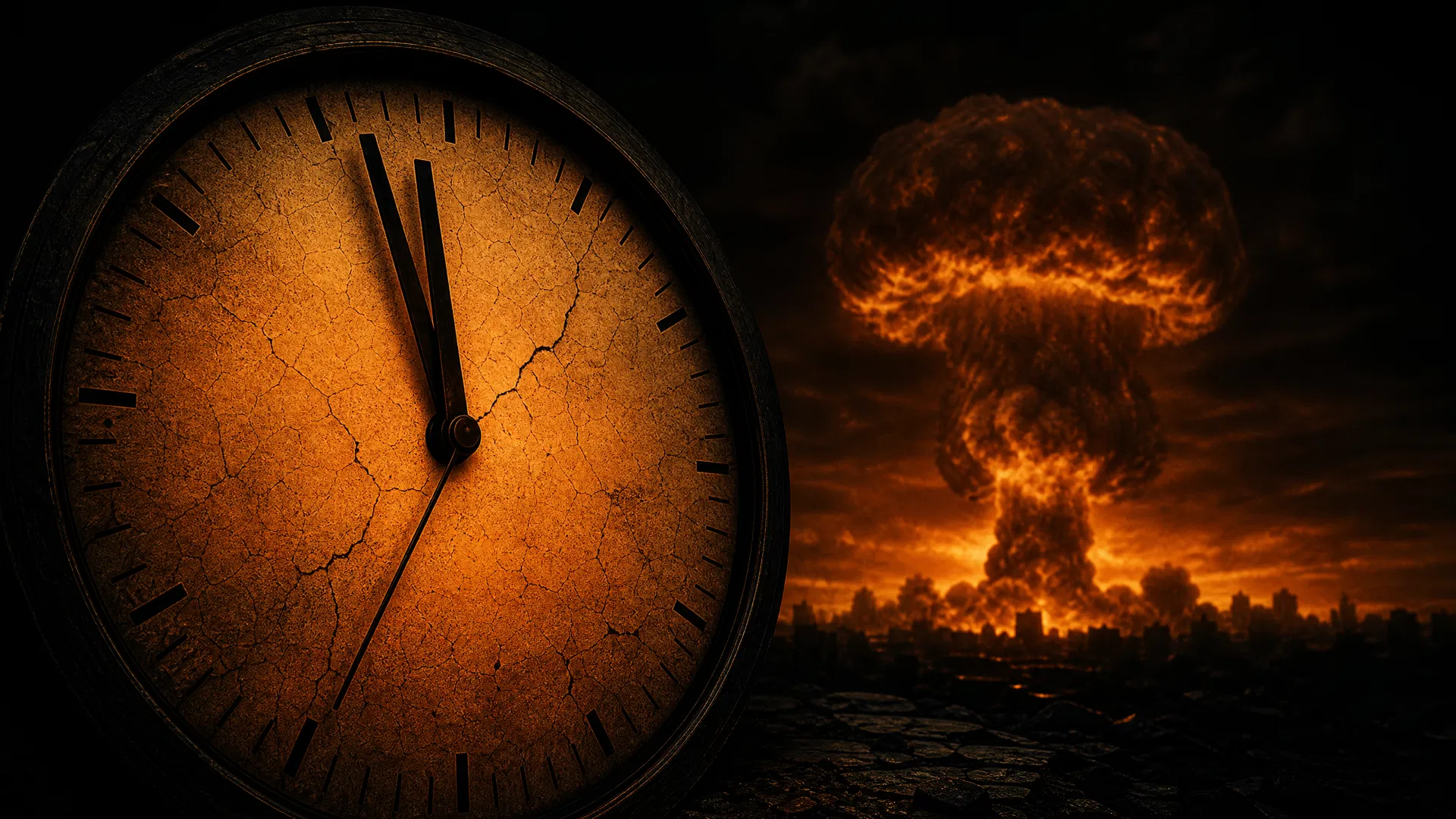
The Doomsday Clock is a symbolic timepiece maintained by the Bulletin of the Atomic Scientists that represents how close humanity is to self-annihilation, with midnight representing global catastrophe. The Clock was created in 1947 by Manhattan Project scientists who wanted a visual metaphor to communicate nuclear danger to the public. The closer the hands are to midnight, the greater the assessed risk.
The Clock is set annually by the Bulletin's Science and Security Board (SASB), which includes Nobel laureates and leading experts in nuclear weapons policy, climate science, and biosecurity. The board evaluates a range of factors — nuclear arsenals, arms control treaties, geopolitical tensions, climate change, and emerging technologies — before deciding whether to move the hands forward or backward.
Critically, the Doomsday Clock is not a prediction. It does not forecast when a nuclear war will begin or how likely one is in any given year. It is a qualitative assessment of global risk trends, intended to prompt policy action and public awareness. As the Bulletin states: "The Clock is not a forecast. It is a call to action."
The 2026 Setting: 85 Seconds to Midnight
On January 27, 2026, the Bulletin's Science and Security Board announced the Clock had been moved to 85 seconds to midnight — four seconds closer than the 89-second setting held in 2025, and the closest the Clock has ever been to midnight since its creation in 1947. The announcement was covered by Reuters, the New York Times, the Washington Post, BBC, CNN, and dozens of other major outlets worldwide.
The board cited four primary factors in its 2026 statement:
The Four 2026 Risk Drivers (per BAS Science and Security Board)
- Collapse of New START: Russia suspended its participation in the New START treaty in 2023, and the treaty expired in February 2026 without a successor agreement. For the first time since 1972, there are no binding legal limits on US or Russian strategic nuclear arsenals. Both countries maintain approximately 1,550 deployed strategic warheads each, with thousands more in reserve.
- Russia-Ukraine nuclear escalation risk: Russia's repeated nuclear signaling during the Ukraine conflict — including references to tactical nuclear weapons and changes to nuclear doctrine — represents the most serious nuclear escalation risk since the Cuban Missile Crisis, according to the board.
- Iran's nuclear program: Iran's continued uranium enrichment to near-weapons-grade levels (60% U-235, compared to the 90% required for a weapon) and reduced cooperation with IAEA inspectors has shortened the estimated "breakout time" to produce enough fissile material for one weapon.
- AI in weapons systems: The rapid deployment of AI in military decision-support systems, autonomous weapons, and cyber operations introduces new risks of miscalculation and accidental escalation that existing arms control frameworks do not address.
Doomsday Clock History: All Settings 1947–2026
The Doomsday Clock has been set 25 times since its creation in 1947. The table below shows every setting, the time to midnight, and the primary reason for the change. All data is sourced directly from the Bulletin of the Atomic Scientists' official timeline.
| Year | Minutes to Midnight | Primary Reason | Direction |
|---|---|---|---|
| 1947 | 7 min | Clock created; US atomic monopoly ending | — |
| 1949 | 3 min | Soviet Union tests first atomic bomb | ⬆ Closer |
| 1953 | 2 min | US and USSR test thermonuclear (hydrogen) bombs | ⬆ Closer |
| 1960 | 7 min | International scientific cooperation; Pugwash Conferences | ⬇ Safer |
| 1963 | 12 min | US-USSR sign Partial Test Ban Treaty | ⬇ Safest ever |
| 1968 | 7 min | France and China develop nuclear weapons; Vietnam War | ⬆ Closer |
| 1969 | 10 min | Nuclear Non-Proliferation Treaty signed | ⬇ Safer |
| 1972 | 12 min | US-USSR sign SALT I and ABM Treaty | ⬇ Safest (tied) |
| 1974 | 9 min | India tests nuclear device; SALT stalls | ⬆ Closer |
| 1980 | 7 min | Soviet invasion of Afghanistan; arms race accelerates | ⬆ Closer |
| 1981 | 4 min | Reagan administration abandons arms control | ⬆ Closer |
| 1984 | 3 min | US-Soviet relations at lowest point since 1950s | ⬆ Closer |
| 1988 | 6 min | US-USSR sign INF Treaty | ⬇ Safer |
| 1990 | 10 min | Fall of Berlin Wall; Cold War ends | ⬇ Safer |
| 1991 | 17 min | US-USSR sign START I; Cold War officially over | ⬇ Safest in history |
| 1995 | 14 min | Post-Cold War nuclear dangers; loose nukes in former USSR | ⬆ Closer |
| 1998 | 9 min | India and Pakistan test nuclear weapons | ⬆ Closer |
| 2002 | 7 min | US withdraws from ABM Treaty; 9/11 terrorism concerns | ⬆ Closer |
| 2007 | 5 min | North Korea tests nuclear weapon; climate change added as factor | ⬆ Closer |
| 2010 | 6 min | Prague Agenda; New START signed; global nuclear security summit | ⬇ Safer |
| 2012 | 5 min | Lack of progress on nuclear disarmament; climate inaction | ⬆ Closer |
| 2015 | 3 min | Modernization of nuclear arsenals; climate change; unchecked technology | ⬆ Closer |
| 2017 | 2.5 min | Trump administration; North Korea ICBM tests | ⬆ Closer |
| 2018 | 2 min | Nuclear modernization; climate; information warfare | ⬆ Closer (tied 1953) |
| 2020 | 100 sec | First time set in seconds; nuclear risk + climate + cyber | ⬆ Closer |
| 2023 | 90 sec | Russia-Ukraine war; nuclear signaling; climate; AI | ⬆ Closer |
| 2024 | 90 sec | Maintained — no improvement in risk factors | — Same |
| 2025 | 89 sec | Moved closer — continued nuclear risk, climate, and AI concerns | ⬆ Closer |
| 2026 | 85 sec | New START expiry; Iran nuclear program; AI weapons; Ukraine | ⬆ Closest ever |
What 85 Seconds Means Practically — And What It Does Not Mean
The most important thing to understand about the Doomsday Clock is the distinction between symbolic risk assessment and operational warning. The Clock is the former, not the latter.
In an actual nuclear emergency, you would receive warning through the Emergency Alert System (EAS) — the same system used for tornado warnings and AMBER alerts — via your phone, radio, and television. FEMA's Integrated Public Alert and Warning System (IPAWS) can deliver a Wireless Emergency Alert (WEA) to every cell phone in an affected area within minutes of a confirmed threat. The Doomsday Clock does not trigger any of these systems.
What the 2026 Clock setting does mean practically is that the geopolitical conditions that could lead to a nuclear incident are more unfavorable than at any point in the past 79 years. The absence of binding arms control treaties, active nuclear signaling in a major European conflict, and the introduction of AI into military decision-making all increase the probability of miscalculation. This is not a reason for panic — it is a reason for preparation.
The Preparedness Paradox
A 2023 FEMA survey found that only 51% of Americans believe they are prepared for a disaster, and fewer than 40% have a 72-hour emergency kit. Yet FEMA's own research shows that individuals who have taken basic preparedness steps have significantly better outcomes in all emergency scenarios — including nuclear incidents. Preparation is not a prediction that something will happen. It is insurance against the possibility that it might.
5-Level Nuclear Preparedness Checklist for 2026
FEMA's nuclear preparedness guidance, published in its 72-Hour Nuclear Detonation Response Guidance (FEMA-654), organizes preparedness into concentric priorities. The checklist below translates that guidance into five actionable levels, ordered by impact per hour of effort.
- ✅ Identify your shelter-in-place location — the most interior room of the most solid building you frequent (home, office, school). Basements and interior rooms on middle floors of concrete buildings offer the best protection.
- ✅ Save emergency numbers — FEMA: 1-800-621-3362; local emergency management agency; nearest hospital.
- ✅ Enable Wireless Emergency Alerts (WEA) on your phone — Settings → Notifications → Emergency Alerts. Ensure they are turned ON.
- ✅ Know your local nuclear power plant — if you live within 50 miles of a nuclear power plant, identify your county's emergency plan at nrc.gov/info-finder/reactors.
- ✅ Water: 1 gallon per person per day for 3 days minimum (family of 4 = 12 gallons). Store in food-grade containers away from direct sunlight.
- ✅ Food: 3-day supply of non-perishable items — canned goods, dried beans, rice, energy bars. Include a manual can opener.
- ✅ Battery-powered or hand-crank radio — NOAA Weather Radio receives official emergency broadcasts when cell networks are overloaded.
- ✅ Flashlight + extra batteries (or hand-crank/solar flashlight).
- ✅ First aid kit — bandages, antiseptic, pain relievers, prescription medications (30-day supply if possible).
- ✅ Copies of important documents — ID, insurance, medical records — in a waterproof bag.
- ✅ Potassium Iodide (KI) tablets — protects the thyroid from radioactive iodine. Required only if directed by authorities. See our complete KI dosage guide for dosing by age. Do not take without official instruction.
- ✅ Plastic sheeting and duct tape — to seal windows and doors in a shelter-in-place scenario. FEMA recommends pre-cutting sheets to window size and labeling them.
- ✅ N95 or P100 respirator masks — for use during evacuation through a contaminated area. Not a substitute for shelter-in-place.
- ✅ Know the 7/10 Rule — radiation from nuclear fallout decreases by a factor of 10 for every 7-fold increase in time. After 7 hours, radiation is 10% of its peak level; after 49 hours, it is 1%. Full explanation here.
- ✅ 14-day food and water supply — FEMA recommends a 2-week supply for extended shelter-in-place scenarios. See our FEMA 14-day kit guide.
- ✅ Water purification capability — water filter (Sawyer Squeeze or LifeStraw), water purification tablets, or a gravity filter. Tap water may be contaminated after a nuclear incident. See our water purification guide.
- ✅ Radiation shielding materials — dense materials (concrete, brick, earth, lead) between you and the outside reduce radiation exposure. See our shielding materials guide.
- ✅ Communication plan — designate an out-of-state contact as a family communication hub. Local phone lines may be overloaded; text messages often go through when calls do not.
- ✅ Geiger counter or radiation detector — allows you to make informed decisions about when it is safe to leave shelter. See our Geiger counter comparison guide.
- ✅ Know nuclear targets near you — understanding whether you live near a high-priority target (ICBM silo, military base, major city) informs your evacuation planning. See our nuclear targets by state guide.
- ✅ Nuclear fallout shelter identification — FEMA's shelter database and your local emergency management office can identify designated shelters in your area. See our fallout shelter guide.
- ✅ First aid training — basic first aid and CPR certification from the American Red Cross significantly improves outcomes in any emergency scenario.
The First 10 Minutes: What FEMA Says to Do
FEMA's nuclear detonation response guidance identifies the first 10 minutes after a nuclear detonation alert as the most critical window for survival. The guidance is summarized in three words: Get Inside. Stay Inside. Stay Tuned.
| Time Window | Priority Action | Why It Matters |
|---|---|---|
| 0–10 minutes | Get inside the nearest solid building immediately. Basement or interior room preferred. | Fallout begins arriving within 10–15 minutes of a detonation. Being inside a solid structure reduces radiation exposure by 10–200× depending on building type. |
| 10–30 minutes | Seal windows and doors with plastic sheeting and duct tape if available. Turn off HVAC. | Reduces inhalation of radioactive particles. HVAC systems can draw contaminated outside air into the building. |
| 30 min – 24 hours | Stay inside. Monitor official alerts via battery-powered radio or phone. Do not go outside. | Radiation levels are highest in the first 24 hours. The 7/10 Rule means waiting 7 hours reduces exposure to 10% of peak levels. |
| 24–72 hours | Follow official evacuation or shelter-in-place instructions. Decontaminate if you went outside. | After 24 hours, outdoor radiation levels have dropped significantly. Official guidance will direct whether to evacuate or remain sheltered. |
| 72 hours+ | Continue following official guidance. Begin using stored food and water supplies. | Tap water and local food supplies may be contaminated. Use stored supplies until authorities confirm safety. |
FEMA emphasizes that any shelter is better than no shelter. Even a car, if you cannot reach a building, provides some protection from fallout particles. The goal is to put as much mass between you and the outside environment as possible.
Is the Doomsday Clock a Reliable Risk Indicator?
The Doomsday Clock has been both praised and criticized since its creation. Understanding its limitations is important for interpreting the 2026 setting accurately.
What the Clock does well: It synthesizes expert consensus from a credible, non-partisan scientific organization. The Bulletin's Science and Security Board includes individuals with direct policy experience — former US Secretaries of Defense, former heads of national laboratories, and Nobel laureates in physics and chemistry. When this group moves the Clock forward, it reflects genuine concern among people who have spent careers working on nuclear risk.
What the Clock does not do: It does not assign probabilities. It does not distinguish between a 1% annual risk and a 10% annual risk. It does not account for deterrence stability, which most nuclear strategists consider robust despite current tensions. Critics, including some arms control experts, argue that the Clock's move to seconds (rather than minutes) in 2020 was partly a communications decision to maintain public attention, and that the incremental moves since then reflect political as much as technical risk assessment.
The practical conclusion: The 2026 Clock setting is a credible signal that expert opinion on nuclear risk is more pessimistic than at any point since the early Cold War. It is not a prediction of imminent catastrophe. The appropriate response is the same as for any elevated risk environment: reasonable preparation, not panic.
Build Your Preparedness: Related Guides
The Doomsday Clock provides the context; the guides below provide the practical steps. Each is based on official FEMA, NRC, and CDC guidance.
Frequently Asked Questions
The Doomsday Clock at 85 seconds to midnight means the Bulletin of the Atomic Scientists' Science and Security Board judges that humanity is closer to global catastrophe — primarily from nuclear weapons, climate change, and disruptive technologies — than at any point since the Clock was created in 1947. It is a symbolic indicator of global risk, not a literal countdown. The January 2026 setting is the closest the Clock has ever been to midnight in its 79-year history.
The Doomsday Clock is set annually by the Science and Security Board (SASB) of the Bulletin of the Atomic Scientists, a nonprofit organization founded in 1945 by scientists who worked on the Manhattan Project. The board includes Nobel laureates and leading experts in nuclear weapons policy, climate science, and biosecurity. The Clock has been set every year since 1947.
No. The 2026 setting of 85 seconds to midnight is the closest the Clock has ever been to midnight in its 79-year history. The previous record was 89 seconds, set in 2025 (itself moved from 90 seconds in 2023–2024). Before that, the closest setting was 2 minutes to midnight in 1953, after both the US and Soviet Union tested thermonuclear weapons, and again in 2018.
According to the Bulletin of the Atomic Scientists' 2026 statement, the four primary factors were: (1) the expiry of the New START nuclear arms control treaty without a successor, leaving no binding limits on US or Russian strategic nuclear arsenals for the first time since 1972; (2) continued nuclear escalation risks from the Russia-Ukraine conflict; (3) Iran's nuclear program advancement; and (4) the rapid development of AI systems with potential military applications, including autonomous weapons.
The Doomsday Clock reaching midnight is a symbolic threshold, not a real-time alert. In an actual nuclear emergency, FEMA and the Emergency Alert System (EAS) would issue official warnings via your phone, radio, and television. The practical response to an actual nuclear detonation alert is to shelter in place immediately — get inside the nearest solid building, move to the most interior room, and stay inside for at least 24 hours to allow radiation levels to decrease per the 7/10 Rule.
FEMA recommends a three-step approach: (1) Build a 72-hour emergency kit including water (1 gallon per person per day), non-perishable food, a battery-powered radio, flashlight, and first aid supplies; (2) Know your local nuclear power plant evacuation zones and your nearest shelter-in-place location; (3) Understand the shelter-in-place protocol — go inside, stay inside, stay tuned to official alerts. Potassium iodide (KI) tablets are recommended for those within 10 miles of a nuclear power plant, per NRC guidance.
Sources & References
- Bulletin of the Atomic Scientists. 2026 Doomsday Clock Statement. January 27, 2026. thebulletin.org/doomsday-clock/2026-statement/
- Bulletin of the Atomic Scientists. Doomsday Clock Timeline. thebulletin.org/doomsday-clock/timeline/
- FEMA. 72-Hour Nuclear Detonation Response Guidance (FEMA-654). fema.gov (PDF)
- Ready.gov. Nuclear Explosion. U.S. Department of Homeland Security. ready.gov/nuclear-explosion
- U.S. Nuclear Regulatory Commission. Operating Nuclear Power Reactors. nrc.gov/info-finder/reactors/
- Federation of American Scientists. Status of World Nuclear Forces 2026. fas.org/initiative/status-world-nuclear-forces/
- FEMA. 2023 National Household Survey on Disaster Preparedness. fema.gov