
Nuclear Power Plant Near Me: Evacuation Zones, Maps & Survival Plan 2026
Key Takeaways
- 94 operating nuclear reactors at 54 plants in the US as of 2026 (NRC). Approximately 3 million Americans live within 10 miles of a plant; over 100 million live within 50 miles.
- Two evacuation zones: The 10-mile Plume EPZ (immediate evacuation/shelter risk) and the 50-mile Ingestion EPZ (food and water contamination risk).
- A reactor accident is not a nuclear bomb — there is no blast wave or immediate explosion. The primary hazard is radioactive contamination dispersed by wind over hours to days.
- Potassium iodide (KI) is pre-distributed by law to residents within 10 miles of every US nuclear plant. Contact your state emergency management agency to obtain yours now, before an emergency.
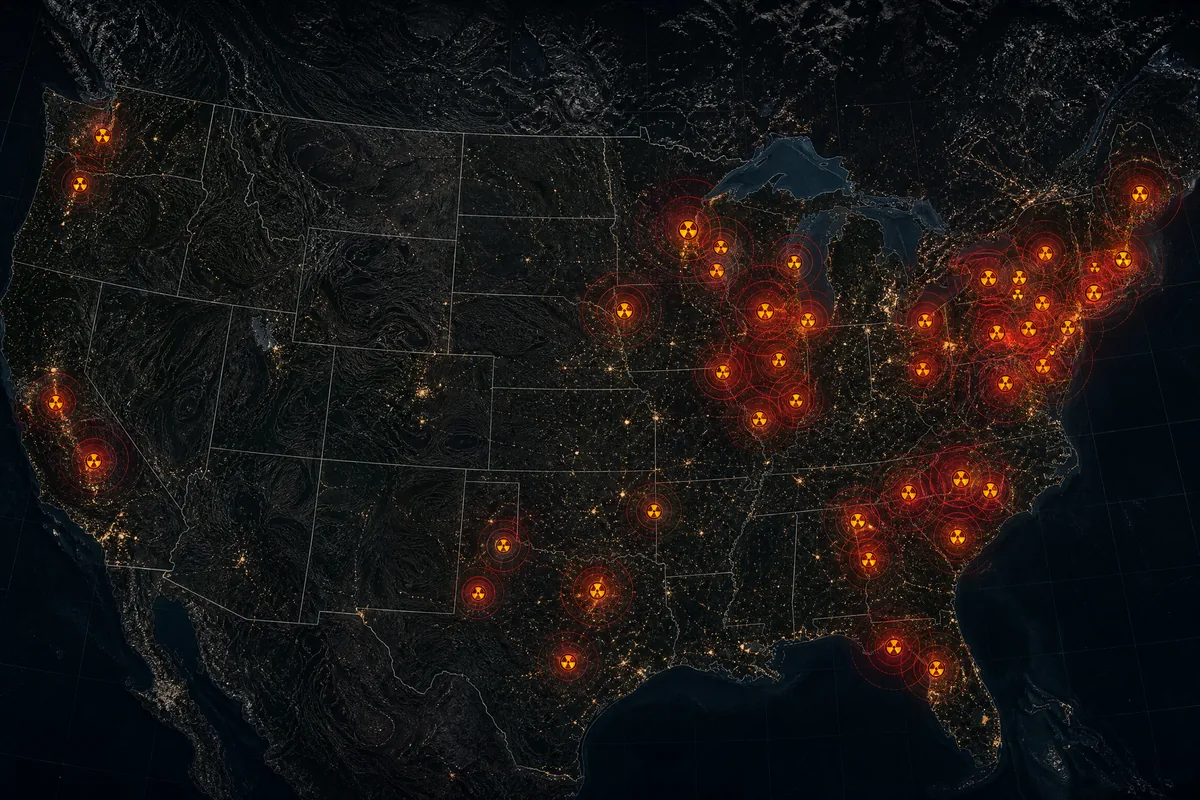
There are 94 operating nuclear reactors at 54 plant sites across the United States as of 2026, according to the Nuclear Regulatory Commission (NRC). Approximately 3 million Americans live within 10 miles of an operating nuclear plant — the zone where evacuation or shelter-in-place may be required in a serious accident. More than 100 million Americans live within 50 miles, the zone where food and water contamination becomes a concern. Most of these people have never read their local emergency plan, do not know whether they are eligible for pre-distributed potassium iodide, and do not know their designated evacuation route.
This guide explains the NRC's Emergency Planning Zone (EPZ) system, what each zone means for your safety, how to find the nuclear plants near you, and what specific actions to take in the first 30 minutes of a declared nuclear plant emergency — before official evacuation orders may be issued.
Nuclear Plant Accident vs. Nuclear Weapon: Critical Differences
A nuclear power plant accident and a nuclear weapon detonation are fundamentally different events that require different responses. Understanding this distinction prevents the most dangerous mistake civilians make in a plant emergency: fleeing immediately by car, which can expose them to more radiation than sheltering in place.
Reactor Accident (Chernobyl/Fukushima Model)
- No explosion — radioactive material is released gradually through steam, fire, or structural failure over hours to days
- Primary hazard: radioactive plume (airborne particles) and later, contamination of food and water
- Time to act: you typically have 30 minutes to several hours before the plume reaches your location
- Shelter-in-place is often safer than immediate evacuation — driving through a plume is more dangerous than staying indoors
- Potassium iodide (KI) is effective against the primary thyroid hazard (radioactive iodine, I-131)
Nuclear Weapon Detonation (Military Attack)
- Immediate blast wave, thermal pulse, and intense prompt radiation within seconds of detonation
- Radioactive fallout arrives 15 minutes to several hours after detonation, depending on distance
- Shelter-in-place is the correct immediate response for anyone outside the immediate blast zone
- See our Nuclear Targets by State guide for weapon-specific guidance
The Two Emergency Planning Zones Explained
An Emergency Planning Zone (EPZ), as defined by the NRC in NUREG-0654 and 10 CFR Part 50 Appendix E, is a geographic area around a nuclear facility for which emergency plans are required to protect the public in the event of a radiological accident. The NRC mandates two distinct EPZs for every operating nuclear power plant in the United States.
Zone 1: The 10-Mile Plume Exposure Pathway EPZ
This is the zone where residents face the greatest risk from direct radiation exposure and inhalation of radioactive particles carried in the airborne plume from a reactor accident.
- Radius: Approximately 10 miles (16 km) from the plant
- Population: ~3 million Americans live within this zone across all US plants
- Required actions: Evacuation or shelter-in-place, as directed by authorities
- KI distribution: Pre-distributed potassium iodide is required by law for all residents in this zone
- Annual notification: Residents receive annual emergency preparedness mailings with evacuation routes and shelter locations
- Siren system: Pole-mounted sirens are installed throughout this zone to alert residents
Zone 2: The 50-Mile Ingestion Exposure Pathway EPZ
This is the zone where the primary concern is not direct radiation exposure but contamination of the food supply — particularly milk, leafy vegetables, and surface water — by radioactive particles that settle from the plume.
- Radius: Approximately 50 miles (80 km) from the plant
- Population: Over 100 million Americans live within this zone across all US plants
- Required actions: Avoid locally produced food and water until authorities declare it safe; do not consume milk from cows that grazed outdoors
- Evacuation: Generally not required unless the accident is extremely severe (beyond Chernobyl scale)
- Duration: Food restrictions may last days to weeks depending on the isotopes released
How to Find Nuclear Plants Near You
The NRC maintains a publicly accessible interactive map of all operating nuclear power plants in the United States, including their Emergency Planning Zone boundaries. To find the plants near you and determine whether you are within a 10-mile or 50-mile EPZ, use the following official resources:
- NRC Interactive Map: nrc.gov/info-finder/reactors/ — search by state or zip code to find all plants and their EPZ boundaries
- FEMA Radiological Emergency Preparedness (REP) Program: fema.gov/emergency-managers/risk-management/radiation — state-specific emergency plans and evacuation route maps
- Your state emergency management agency: Search "[your state] nuclear power plant emergency plan" — most states publish detailed EPZ maps and evacuation route guides for residents
- Duke Energy, Exelon, Dominion Energy plant pages: The major nuclear plant operators publish annual Emergency Information brochures for residents within 10 miles, including evacuation routes and shelter locations
Major US Nuclear Power Plants by State (2026)
The following table lists the major operating nuclear power plants in the United States as of 2026, organized by state, with the nearest major city and the approximate population within the 10-mile EPZ. Data sourced from the NRC Power Reactor Status Reports and US Census Bureau estimates.
| State | Plant Name | Operator | Reactors | Nearest City | Pop. within 10 mi |
|---|---|---|---|---|---|
| Arkansas Nuclear | AR | 2 | Entergy Nuclear Operations | 6 mi WNW of Russellville | Russellville (~6 mi) |
| Beaver Valley | PA | 2 | Vistra Corporation | 17 mi W of McCandless | Pittsburgh area (~25 mi) |
| Braidwood | IL | 2 | Constellation Energy | 20 mi SSW of Joliet | Joliet (~20 mi) |
| Browns Ferry | AL | 3 | Tennessee Valley Authority | 32 mi W of Huntsville | Huntsville (~32 mi) |
| Brunswick | NC | 2 | Duke Energy Progress | 30 mi S of Wilmington | Wilmington (~30 mi) |
| Byron | IL | 2 | Constellation Energy | 17 mi SW of Rockford | Rockford (~17 mi) |
| Callaway | MO | 1 | Ameren UE | 25 mi ENE of Jefferson City | Jefferson City (~25 mi) |
| Calvert Cliffs | MD | 2 | Constellation Energy | 40 mi S of Annapolis | Annapolis (~40 mi) / DC (~60 mi) |
| Catawba | SC | 2 | Duke Energy Carolinas | 18 mi S of Charlotte, NC | Charlotte (~18 mi) |
| Clinton | IL | 1 | Constellation Energy | 23 mi SSE of Bloomington | Bloomington (~23 mi) |
| Columbia Generating Station | WA | 1 | Energy Northwest | 20 mi NNE of Pasco | Pasco (~20 mi) / Richland (~15 mi) |
| Comanche Peak | TX | 2 | Vistra Operations | 40 mi SW of Fort Worth | Fort Worth (~40 mi) |
| Cooper | NE | 1 | Nebraska Public Power District | 23 mi S of Nebraska City | Nebraska City (~23 mi) |
| D.C. Cook | MI | 2 | Indiana/Michigan Power Co. | 13 mi S of Benton Harbor | Benton Harbor (~13 mi) / South Bend, IN (~30 mi) |
| Davis-Besse | OH | 1 | Energy Harbor Nuclear Corp. | 21 mi ESE of Toledo | Toledo (~21 mi) |
| Diablo Canyon | CA | 2 | Pacific Gas & Electric | 12 mi WSW of San Luis Obispo | San Luis Obispo (~12 mi) |
| Dresden | IL | 2 | Constellation Energy | 25 mi SW of Joliet | Joliet (~25 mi) |
| Farley | AL | 2 | Southern Nuclear Operating Co. | 18 mi E of Dothan | Dothan (~18 mi) |
| Fermi 2 | MI | 1 | DTE Electric Company | 25 mi NE of Toledo, OH | Toledo (~25 mi) / Detroit (~35 mi) |
| FitzPatrick | NY | 1 | Constellation Energy | 6 mi NE of Oswego | Oswego (~6 mi) / Syracuse (~35 mi) |
| Ginna | NY | 1 | Constellation Energy | 20 mi NE of Rochester | Rochester (~20 mi) |
| Grand Gulf | MS | 1 | Entergy Nuclear Operations | 20 mi S of Vicksburg | Vicksburg (~20 mi) |
| Hatch | GA | 2 | Southern Nuclear Operating Co. | 20 mi S of Vidalia | Vidalia (~20 mi) |
| Hope Creek | NJ | 1 | PSEG Nuclear | 18 mi SE of Wilmington, DE | Wilmington, DE (~18 mi) / Philadelphia (~40 mi) |
| La Salle | IL | 2 | Constellation Energy | 11 mi SE of Ottawa | Ottawa (~11 mi) |
| Limerick | PA | 2 | Constellation Energy | 21 mi NW of Philadelphia | Philadelphia (~21 mi) |
| McGuire | NC | 2 | Duke Energy Carolinas | 17 mi N of Charlotte | Charlotte (~17 mi) |
| Millstone | CT | 2 | Dominion Generation | 3.2 mi WSW of New London | New London (~3 mi) |
| Monticello | MN | 1 | Northern States Power – MN | 35 mi NW of Minneapolis | Minneapolis (~35 mi) |
| Nine Mile Point | NY | 2 | Constellation Energy | 6 mi NE of Oswego | Oswego (~6 mi) / Syracuse (~35 mi) |
| North Anna | VA | 2 | Dominion Generation | 40 mi NW of Richmond | Richmond (~40 mi) |
| Oconee | SC | 3 | Duke Energy Carolinas | 30 mi W of Greenville | Greenville (~30 mi) |
| Palisades | MI | 1 | Holtec Palisades (restarted 2025) | 5 mi S of South Haven | South Haven (~5 mi) / Kalamazoo (~40 mi) |
| Palo Verde | AZ | 3 | Arizona Public Service Co. | 50 mi W of Phoenix | Phoenix (~50 mi) |
| Peach Bottom | PA | 2 | Constellation Energy | 17.9 mi S of Lancaster | Lancaster (~18 mi) / Baltimore (~55 mi) |
| Perry | OH | 1 | FirstEnergy Nuclear Operating Co. | 35 mi NE of Cleveland | Cleveland (~35 mi) |
| Point Beach | WI | 2 | NextEra Energy Point Beach | 13 mi NNW of Manitowoc | Manitowoc (~13 mi) / Green Bay (~35 mi) |
| Prairie Island | MN | 2 | Northern States Power – MN | 28 mi SE of Minneapolis | Minneapolis (~28 mi) |
| Quad Cities | IL | 2 | Constellation Energy | 20 mi NE of Moline | Moline (~20 mi) |
| River Bend | LA | 1 | Entergy Nuclear Operations | 24 mi NNW of Baton Rouge | Baton Rouge (~24 mi) |
| Robinson 2 | SC | 1 | Duke Energy Progress | 26 mi NW of Florence | Florence (~26 mi) |
| Saint Lucie | FL | 2 | Florida Power & Light | 10 mi SE of Fort Pierce | Fort Pierce (~10 mi) |
| Salem | NJ | 2 | PSEG Nuclear | 18 mi S of Wilmington, DE | Wilmington, DE (~18 mi) / Philadelphia (~40 mi) |
| Seabrook | NH | 1 | NextEra Energy Seabrook | 13 mi S of Portsmouth | Portsmouth (~13 mi) / Boston (~40 mi) |
| Sequoyah | TN | 2 | Tennessee Valley Authority | 16 mi NE of Chattanooga | Chattanooga (~16 mi) |
| Shearon Harris | NC | 1 | Duke Energy Progress | 20 mi SW of Raleigh | Raleigh (~20 mi) |
| South Texas | TX | 2 | STP Nuclear Operating Co. | 90 mi SW of Houston | Houston (~90 mi) |
| Summer (V.C.) | SC | 1 | South Carolina Electric & Gas | 26 mi NW of Columbia | Columbia (~26 mi) |
| Surry | VA | 2 | Dominion Generation | 17 mi NW of Newport News | Newport News (~17 mi) / Norfolk (~25 mi) |
| Susquehanna | PA | 2 | Susquehanna Nuclear | 70 mi NE of Harrisburg | Berwick (~3 mi) / Wilkes-Barre (~20 mi) |
| Turkey Point | FL | 2 | Florida Power & Light | 20 mi S of Miami | Miami (~20 mi) |
| Vogtle | GA | 4 | Southern Nuclear Operating Co. | 26 mi SE of Augusta | Augusta (~26 mi) |
| Waterford 3 | LA | 1 | Entergy Nuclear Operations | 25 mi W of New Orleans | New Orleans (~25 mi) |
| Watts Bar | TN | 2 | Tennessee Valley Authority | 60 mi SW of Knoxville | Knoxville (~60 mi) / Chattanooga (~50 mi) |
| Wolf Creek | KS | 1 | Wolf Creek Nuclear Operating Corp. | 3.5 mi NE of Burlington | Burlington (~4 mi) / Wichita (~100 mi) |
Source: NRC Power Reactor Status Reports, 2026. Population estimates based on US Census Bureau data. This table is not exhaustive — visit nrc.gov for the complete list of all 54 operating plant sites.
What to Do in the First 30 Minutes of a Nuclear Plant Emergency
The first 30 minutes after a nuclear plant emergency is declared are the most critical for your safety. The actions you take in this window — before the radioactive plume may reach your location — determine your radiation exposure for the entire event. The following protocol is based on FEMA's Radiological Emergency Preparedness (REP) Program guidance and NRC emergency response planning standards.
-
1Tune to Emergency Alert System (EAS) immediately
Turn on your battery-powered NOAA Weather Radio or local AM/FM EAS station. Do not rely on social media or internet news — official evacuation orders are issued through EAS. Write down your local EAS station frequency now: it is listed in the annual emergency preparedness brochure mailed to residents within 10 miles of your nearest plant.
-
2Determine your zone and distance from the plant
If you are within 10 miles and authorities issue an evacuation order, leave immediately using your designated evacuation route — not the fastest route, which may be congested. If you are within 10 miles and authorities issue a shelter-in-place order, do not evacuate. Driving through a radioactive plume is more dangerous than staying in a well-sealed building.
-
3Shelter-in-place: seal your building
If instructed to shelter-in-place: close all windows, doors, and fireplace dampers. Turn off all HVAC systems (heating, ventilation, air conditioning) that draw outside air. Seal gaps around doors and windows with tape and plastic sheeting if available. Move to an interior room on the middle floor — avoid basements (radon accumulation) and top floors (closer to the plume).
-
4Take potassium iodide (KI) only when instructed
If you have been pre-distributed KI tablets, take them only when instructed by authorities — not preemptively. KI protects the thyroid from radioactive iodine (I-131) but has no effect on other radioactive isotopes. Taking KI too early or unnecessarily can cause side effects. See our Potassium Iodide Dosage Guide for age-specific dosing.
-
5Do not consume local food or water until cleared
Even if you are beyond 10 miles, do not consume locally produced milk, leafy vegetables, or surface water until authorities declare them safe. Radioactive iodine (I-131) concentrates in the milk of cows that graze on contaminated grass — this was the primary exposure pathway for most Chernobyl and Fukushima thyroid cases. Use stored water and sealed food from your emergency kit.
-
6Monitor radiation with your Geiger counter
If you have a Geiger counter, monitor outdoor radiation levels from inside your shelter. Record readings every 30 minutes. When readings drop below 2 mR/hr (0.02 mSv/hr), brief outdoor activity may be acceptable. See our Best Geiger Counter Guide for recommended models and reading interpretation.
Shelter-in-Place vs. Evacuation: How to Decide
The shelter-in-place vs. evacuation decision is the most consequential choice you will make in a nuclear plant emergency. The NRC and FEMA guidance is clear: always follow official instructions from emergency management authorities. However, if official instructions are unavailable or delayed, the following framework — based on FEMA's Protective Action Decision-Making guidance — provides a rational basis for your decision.
| Your Situation | Recommended Action | Rationale |
|---|---|---|
| Within 2 miles, accident just announced | Evacuate immediately | Too close for shelter to be effective; leave before plume arrives |
| 2–10 miles, plume not yet arrived | Await official instruction; shelter if no order within 15 min | Shelter is highly effective; evacuation through arriving plume is dangerous |
| 2–10 miles, plume already overhead | Shelter-in-place immediately | Driving through the plume multiplies your exposure |
| 10–50 miles, any scenario | Shelter-in-place; avoid local food/water | Direct radiation risk is low; ingestion pathway is primary concern |
| Beyond 50 miles | Monitor news; normal activities | Direct radiation risk is negligible; follow food/water advisories if issued |
Frequently Asked Questions
The NRC defines two Emergency Planning Zones (EPZs) around every US nuclear plant: the 10-mile Plume Exposure Pathway EPZ, where residents may need to shelter-in-place or evacuate in the event of a serious accident, and the 50-mile Ingestion Pathway EPZ, where food and water contamination is the primary concern. Living beyond 50 miles from a nuclear plant significantly reduces your risk from a reactor accident. However, no distance guarantees complete safety — wind direction, accident severity, and terrain all affect fallout dispersal.
The 10-mile Emergency Planning Zone (EPZ) is the area around a nuclear power plant where the NRC requires detailed emergency plans to protect the public from direct radiation exposure and radioactive plume inhalation in the event of a serious accident. Within this zone, residents receive annual emergency preparedness information, including evacuation routes, shelter locations, and potassium iodide (KI) distribution plans. The 10-mile radius is based on NRC Regulatory Guide 1.101 and NUREG-0654 planning standards.
If a nuclear power plant meltdown is announced near you: (1) Immediately tune to your local Emergency Alert System (EAS) station or NOAA Weather Radio for official instructions. (2) If you are within 10 miles and instructed to evacuate, leave immediately using the designated evacuation routes — do not wait. (3) If you are within 10 miles and instructed to shelter-in-place, go indoors, close all windows and doors, turn off HVAC systems, and seal gaps with tape. (4) If you have been pre-distributed potassium iodide (KI), take it only when instructed by authorities. (5) Do not consume locally produced food or water until authorities declare it safe.
A nuclear power plant accident (like Chernobyl or Fukushima) and a nuclear weapon detonation are fundamentally different events. A reactor accident releases radioactive material gradually over hours to days, primarily through steam releases, fire, or structural failure — there is no nuclear explosion. The primary hazard is radioactive contamination of air, water, and food. A nuclear weapon detonation produces an immediate blast wave, thermal pulse, and intense prompt radiation, followed by radioactive fallout. The immediate hazard radius of a weapon is far larger, but a reactor accident can release more total radioactive material over a longer period.
Yes — the NRC requires states to make potassium iodide (KI) available to residents within 10 miles of a nuclear power plant. Distribution methods vary by state: some mail KI tablets directly to households within the 10-mile EPZ, others distribute through local pharmacies, fire stations, or community centers. KI protects the thyroid gland from radioactive iodine (I-131) released in a reactor accident, but it does not protect against other radioactive isotopes. Contact your state emergency management agency to find out if you are eligible for pre-distributed KI.
As of 2026, the states with the most operating nuclear power plants are: Illinois (6 plants, 11 reactors — the most of any state), Pennsylvania (5 plants, 9 reactors), South Carolina (4 plants, 7 reactors), New York (4 plants, 6 reactors), and North Carolina (3 plants, 5 reactors). The Northeast corridor (from Virginia to Maine) has the highest density of nuclear plants relative to population, meaning a larger percentage of the population lives within 50 miles of a plant in this region than anywhere else in the country.
DISCLAIMER
This guide is for educational purposes only. In any nuclear plant emergency, always follow official instructions from the NRC, FEMA, and your local emergency management authorities. Plant data and population estimates are based on NRC and US Census Bureau data as of 2026 and may change. Nuclear Ready is not affiliated with any nuclear plant operator or government agency.