
Nuclear Targets by State 2026: US Attack Map & Survival Guide
Key Takeaways
- The US maintains approximately 400 active Minuteman III ICBM silos across five states (MT, ND, WY, NE, MO) — these are the highest-priority targets in any adversary's first strike, according to declassified DoD targeting doctrine.
- The 7/10 Rule (FEMA-validated): radiation intensity drops to 10% of peak at 7 hours, 1% at 49 hours, and 0.1% at two weeks — making 24–72 hours of shelter-in-place the critical survival window for most Americans.
- No state is entirely safe, but Maine, the Upper Peninsula of Michigan, northern Wisconsin, and interior Nevada have the lowest combined risk from blast, fallout, and secondary effects, per the Brown-Columbia fallout modeling project.
- Fallout travels downwind — prevailing US winds move west-to-east, meaning populations east of any strike zone face significant fallout risk even if they are hundreds of miles from the detonation.
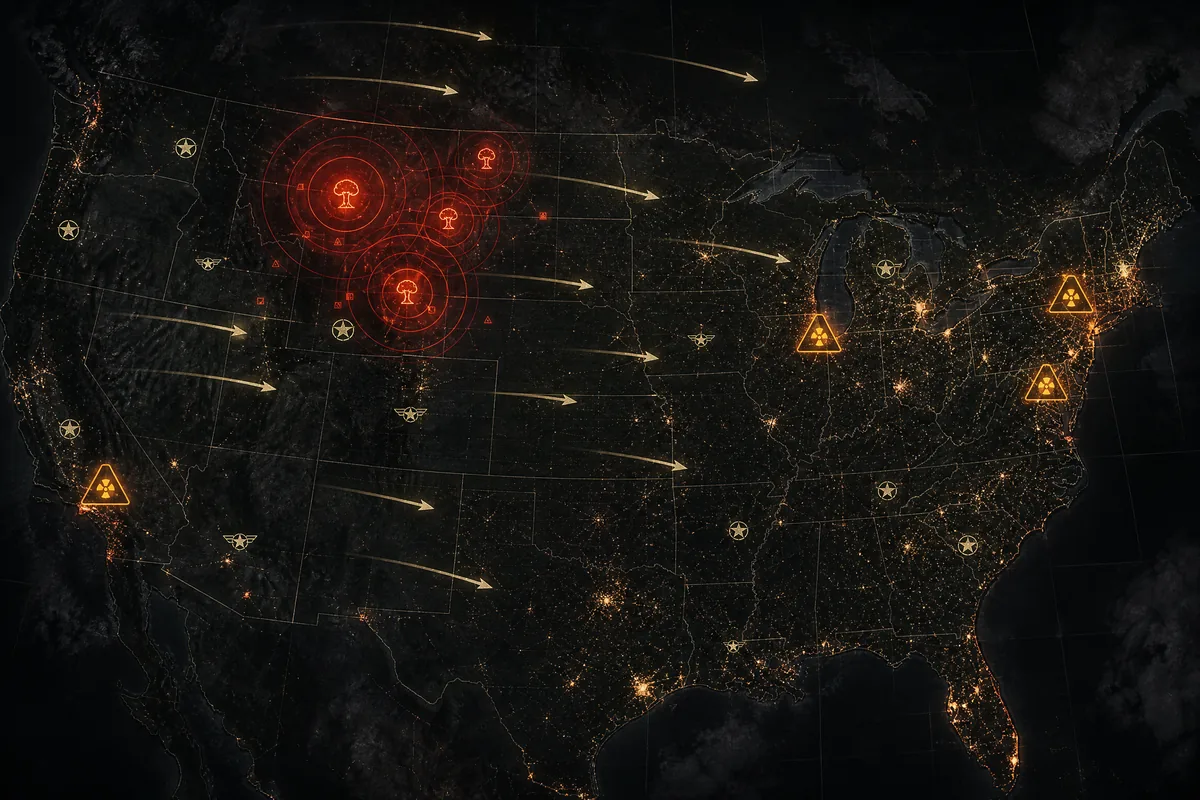
Understanding your proximity to a nuclear target is the first step in any serious preparedness plan. The United States Strategic Command (USSTRATCOM), headquartered at Offutt Air Force Base in Nebraska, oversees a nuclear arsenal of approximately 3,700 warheads as of the 2026 Bulletin of the Atomic Scientists assessment. Any adversary planning a first strike would prioritize eliminating the US nuclear deterrent — which means the ICBM silo fields of Montana, North Dakota, and Wyoming would be the first targets hit, not the largest cities. This guide provides a comprehensive, state-by-state breakdown of nuclear targets, the science of fallout direction, and the specific survival actions appropriate for each risk zone.
This information is drawn from declassified government documents, FEMA nuclear detonation response planning guidance (FEMA-654), the Congressional EMP Commission, and the Federation of American Scientists' Nuclear Information Project. The goal is not to cause alarm, but to provide the factual foundation for a rational preparedness plan — one that gives you and your family the best possible chance of survival regardless of where you live.
What Makes a Location a Nuclear Target?
A nuclear target, as defined by the Department of Defense's nuclear targeting doctrine, is any location whose destruction would meaningfully degrade an adversary's ability to wage war, sustain its economy, or maintain political control. The DoD classifies US targets into four primary categories, each with a distinct threat profile and survival implication for nearby civilians.
The first and highest-priority category is nuclear force targets — ICBM silo fields, submarine bases, and bomber airfields. Destroying these eliminates the US ability to retaliate, which is why they would be struck first and with the largest warheads. The second category is command-and-control targets — the Pentagon, NORAD, and hardened command bunkers. The third category is military-industrial targets — defense manufacturing plants, naval shipyards, and logistics hubs. The fourth and final category, struck only in a full countervalue exchange, is population centers — major cities targeted to maximize economic disruption and civilian casualties. Understanding which category applies to your region determines both your risk level and the appropriate survival response.
The Federation of American Scientists' Nuclear Information Project estimates that Russia maintains approximately 1,550 deployed strategic warheads as of 2026, while China has approximately 500 deployed warheads. In a limited first strike targeting only US nuclear forces, roughly 400–600 warheads would be directed at the ICBM silo fields and submarine bases. In a full countervalue exchange, all major US cities with populations above 100,000 would be at risk.
The 7/10 Rule: How Radiation Decays After a Nuclear Strike
The 7/10 Rule is a FEMA-validated mathematical formula that describes the decay rate of fallout radiation from a nuclear fission weapon. Developed from data collected during US nuclear weapons testing in the 1950s and formalized in FEMA's nuclear detonation response guidance, the rule states: for every 7-fold increase in time after a detonation, radiation intensity decreases by a factor of 10.
This rule is the scientific basis for FEMA's shelter-in-place guidance and is critical for understanding when it is safe to leave shelter, move to a better shelter, or begin evacuation. The practical implication is that the first 24 hours are the most dangerous — radiation levels are at their highest — and that waiting even 48–72 hours dramatically reduces your cumulative exposure. The table below shows the decay curve for a reference peak radiation level of 1,000 R/hr (roentgens per hour) immediately after fallout deposition:
| Time After Detonation | Radiation Level (R/hr) | % of Peak | Action Guidance (FEMA) |
|---|---|---|---|
| 1 hour | ~1,000 R/hr | 100% | Stay inside — lethal exposure in minutes |
| 7 hours | ~100 R/hr | 10% | Stay inside — still dangerous without protection |
| 24 hours | ~25–40 R/hr | ~3% | Remain sheltered; brief exits only if critical |
| 49 hours (2 days) | ~10 R/hr | 1% | Brief outdoor activity possible with monitoring |
| 2 weeks | ~1 R/hr | 0.1% | Cautious outdoor activity; evacuation feasible |
| 3 months | <0.1 R/hr | <0.01% | Background-level radiation in most areas |
Source: FEMA Nuclear Detonation Response Guidance (FEMA-654); National Council on Radiation Protection and Measurements (NCRP Report No. 138). Values are illustrative for a 1 MT surface burst at 1 mile downwind; actual levels vary significantly by yield, burst height, and distance.
The critical insight from this table is that the decision to shelter for 24–72 hours is not a minor inconvenience — it is the difference between a survivable radiation dose and a lethal one. A person who remains in a well-shielded basement for 48 hours after a detonation 10 miles away will receive a fraction of the dose of someone who evacuates immediately by car through the fallout zone.
Nuclear Targets by State: Complete Reference Table
The following table consolidates nuclear target data from declassified DoD documents, the Federation of American Scientists' Nuclear Information Project, FEMA nuclear planning guidance, and the World Population Review's 2026 nuclear targets database. Risk levels reflect the probability of being within a blast or heavy fallout zone in a limited nuclear exchange targeting US nuclear forces (Tier 1) or a full countervalue exchange (Tier 2).
| State | Primary Target(s) | Target Type | Risk Level |
|---|---|---|---|
| Montana | Malmstrom AFB (Great Falls) — 150 Minuteman III silos | ICBM Silo Field | HIGH |
| North Dakota | Minot AFB — 150 Minuteman III silos + B-52 bombers | ICBM Silo Field / Bomber Base | HIGH |
| Wyoming | F.E. Warren AFB (Cheyenne) — 150 Minuteman III silos | ICBM Silo Field | HIGH |
| Missouri | Whiteman AFB — B-2 Spirit stealth bombers (sole base) | Strategic Bomber Base | HIGH |
| Nebraska | Offutt AFB (Omaha) — USSTRATCOM headquarters | Command & Control | HIGH |
| Virginia | Pentagon (Arlington); Naval Station Norfolk (world's largest naval base) | Command & Control / Naval Base | HIGH |
| District of Columbia | Washington D.C. — political leadership, federal agencies | Population / Command Center | HIGH |
| New York | New York City (Manhattan); potential secondary: Fort Drum (10th Mountain Division) | Major City / Military Base | HIGH |
| California | Los Angeles; San Diego (Naval Base); San Francisco; Vandenberg SFB (missile testing) | Major Cities / Naval Base / Space Force | HIGH |
| Georgia | Naval Submarine Base Kings Bay — Ohio-class SSBN submarines | Submarine Base | HIGH |
| Washington State | Naval Base Kitsap (Bangor) — Trident SSBN submarines; Jim Creek Naval Radio Station | Submarine Base / Command & Control | HIGH |
| Colorado | NORAD / Peterson SFB (Colorado Springs); Cheyenne Mountain Complex; Denver | Command & Control / Major City | HIGH |
| Pennsylvania | Philadelphia; Raven Rock Mountain Complex (Site R) — alternate National Command Authority | Major City / Command Bunker | HIGH |
| Texas | Dallas-Fort Worth; Houston; Pantex Plant (Amarillo) — only US nuclear warhead assembly/disassembly facility; Dyess AFB (B-1B bombers) | Major Cities / Nuclear Facility / Bomber Base | HIGH |
| Illinois | Chicago — third-largest US city, financial hub | Major City | MEDIUM |
| Florida | Miami; MacDill AFB (CENTCOM/SOCOM headquarters); Cape Canaveral | Major City / Military Command | MEDIUM |
| Louisiana | Barksdale AFB (Shreveport) — B-52H bombers, Air Force Global Strike Command | Strategic Bomber Base | MEDIUM |
| New Mexico | Kirtland AFB (Albuquerque) — nuclear weapons storage; Sandia National Laboratories; Los Alamos National Laboratory | Nuclear Storage / Research | MEDIUM |
| Nevada | Las Vegas; Nellis AFB; Nevada National Security Site (former test site) | Major City / Military Base | MEDIUM |
| Utah | Hill AFB (Ogden) — nuclear weapons storage; Salt Lake City | Nuclear Storage / Major City | MEDIUM |
| Hawaii | Pearl Harbor / Joint Base Pearl Harbor-Hickam; VLF Transmitter Lualualei (submarine communications) | Naval Base / Command & Control | MEDIUM |
| Maine | VLF Transmitter Cutler (submarine communications) — remote location, minimal collateral risk | Command & Control (Remote) | LOW |
| Ohio | Wright-Patterson AFB (Dayton) — Air Force Materiel Command; secondary: Cleveland, Columbus | Military Base / Secondary Cities | MEDIUM |
| Maryland | Fort Meade (NSA headquarters); Andrews AFB; proximity to DC fallout zone | Intelligence / Military Base | HIGH |
| Alaska | Eielson AFB; Clear Space Force Station (missile warning radar); Fort Wainwright | Military Bases / Radar | MEDIUM |
| South Carolina | Shaw AFB; potential fallout from Kings Bay (GA) strike | Military Base / Fallout Zone | MEDIUM |
| North Carolina | Fort Bragg (largest US military installation by population); Seymour Johnson AFB (F-15E Strike Eagles) | Major Military Base | MEDIUM |
| Arizona | Davis-Monthan AFB (aircraft boneyard); Luke AFB; Phoenix (secondary) | Military Bases / Secondary City | MEDIUM |
| Kansas | McConnell AFB (Wichita) — KC-46 tanker aircraft; Wichita (secondary); potential fallout from Whiteman AFB (MO) | Military Base / Fallout Zone | MEDIUM |
| Michigan | Detroit (secondary city target); Selfridge ANGB; Upper Peninsula — no significant targets | Secondary City / National Guard Base | LOW |
| Wisconsin | Milwaukee (secondary city target); Volk Field ANGB; northern Wisconsin — no significant targets | Secondary City / National Guard Base | LOW |
| Minnesota | Minneapolis-St. Paul (secondary city); Minneapolis-St. Paul ARS; potential fallout from Minot AFB (ND) | Secondary City / Fallout Zone | MEDIUM |
| Idaho | Mountain Home AFB (F-15E fighters); INL (Idaho National Laboratory — nuclear research); potential fallout from Malmstrom AFB (MT) | Military Base / Nuclear Research / Fallout | MEDIUM |
| Oregon | Portland (secondary city); Klamath Falls ANG; potential fallout from Kitsap (WA) | Secondary City / Fallout Zone | MEDIUM |
| Tennessee | Oak Ridge National Laboratory (nuclear research, uranium enrichment history); Arnold AFB | Nuclear Research Facility | MEDIUM |
| South Dakota | Ellsworth AFB (B-21 Raider bombers — new deployment); potential fallout from Minot AFB (ND) and F.E. Warren (WY) | Strategic Bomber Base / Fallout Zone | HIGH |
| Iowa | No primary targets; potential fallout from Offutt AFB (NE) and Whiteman AFB (MO) | Fallout Zone Only | MEDIUM |
| Indiana | Crane Army Ammunition Activity (naval weapons support); Indianapolis (secondary city) | Military Support / Secondary City | LOW |
| Kentucky | Fort Campbell (101st Airborne Division); Bluegrass Army Depot (chemical weapons destruction) | Major Military Base | MEDIUM |
| Mississippi | Columbus AFB (pilot training); Keesler AFB; potential fallout from Barksdale AFB (LA) | Military Bases / Fallout Zone | LOW |
| Alabama | Redstone Arsenal (missile development); Maxwell AFB; Huntsville (defense industry) | Military/Defense Industry | MEDIUM |
| Arkansas | Little Rock AFB (C-130J transports); potential fallout from Whiteman AFB (MO) | Military Base / Fallout Zone | LOW |
| Oklahoma | Tinker AFB (Oklahoma City) — E-3 AWACS, B-52 depot; Vance AFB | Major Air Logistics Base | MEDIUM |
| New Hampshire | No primary targets; potential fallout from Boston (MA) or Portsmouth Naval Shipyard | Fallout Zone Only | LOW |
| Vermont | No primary targets; Burlington ANG; potential fallout from Boston (MA) | Fallout Zone Only | LOW |
| Massachusetts | Boston; Hanscom AFB; Portsmouth Naval Shipyard (NH border) — nuclear submarine maintenance | Major City / Naval Shipyard | MEDIUM |
| Connecticut | New London / Groton — Naval Submarine Base New London (largest submarine base on East Coast) | Submarine Base | HIGH |
| Rhode Island | Newport Naval Station; potential fallout from New London (CT) strike | Naval Base / Fallout Zone | MEDIUM |
| New Jersey | McGuire-Dix-Lakehurst (joint base); proximity to NYC and Philadelphia fallout zones | Military Base / Fallout Zone | HIGH |
| Delaware | Dover AFB (largest US Air Mobility Command base); proximity to Philadelphia and DC fallout zones | Military Base / Fallout Zone | HIGH |
| West Virginia | Greenbrier bunker (Congressional continuity facility); potential fallout from DC and Pittsburgh | Command Bunker / Fallout Zone | MEDIUM |
| Virginia (cont.) | Quantico (FBI/Marine Corps); Langley AFB (Air Combat Command HQ) | Military/Intelligence | HIGH |
Sources: Federation of American Scientists Nuclear Information Project (2026); FEMA Nuclear Detonation Response Guidance (FEMA-654); Bulletin of the Atomic Scientists Nuclear Notebook (thebulletin.org/nuclear-notebook); World Population Review Nuclear Targets by State (2026); declassified SIOP targeting documents via National Security Archive.
High-Risk States: Survival Protocol for ICBM Silo Zones
High-risk states are those containing primary nuclear force targets — ICBM silo fields, strategic bomber bases, and submarine bases — that would be struck in the opening minutes of any nuclear exchange. Residents of these states face the shortest warning time (ICBM flight time from Russia to the continental US is 25–30 minutes; submarine-launched missiles can arrive in as few as 8–12 minutes) and the highest probability of being within the blast or heavy fallout zone.
🔴 Montana, North Dakota, Wyoming — ICBM Silo States
- Threat: 450 Minuteman III silos spread across these three states are the single highest-priority target in any adversary's strike plan. Each silo would likely receive one or more warheads in a first strike.
- Warning time: 8–25 minutes depending on launch platform. NOAA Weather Radio and the Emergency Alert System (EAS) are your only reliable warning sources.
- Immediate action: If you see a bright flash, immediately take cover behind any solid object, close your eyes, and cover exposed skin. Do not look at the fireball. Move to the lowest floor of the most substantial building within 15 minutes.
- Shelter priority: Concrete or brick buildings, basements, or interior rooms on the lowest floor. A basement provides 10x more protection than an upper floor. FEMA's Protection Factor (PF) for a basement is approximately 200 (reduces radiation by a factor of 200).
- Fallout direction: Prevailing winds in these states move generally west-to-east and northwest-to-southeast. Fallout from Malmstrom AFB strikes would move toward central Montana and into the Dakotas; fallout from Minot AFB would move toward Minnesota and Wisconsin.
- Minimum shelter duration: 72 hours before any outdoor activity. Residents within 10 miles of a silo field should plan for 2 weeks of shelter supplies.
🔴 Missouri — Whiteman AFB (B-2 Stealth Bombers)
- Threat: Whiteman AFB in rural Johnson County is the only base in the world that houses the B-2 Spirit stealth bomber fleet. Destroying it eliminates the US airborne nuclear deterrent. A single large warhead would be directed at the base.
- Fallout direction: Prevailing winds move northeast — fallout would affect the Kansas City metropolitan area and move toward Illinois and Indiana.
- Survival note: Kansas City is approximately 70 miles from Whiteman AFB. Residents of Kansas City would not be in the immediate blast zone but would face significant fallout within 2–6 hours of detonation depending on wind speed.
🔴 Nebraska — Offutt AFB (USSTRATCOM)
- Threat: Offutt AFB in Bellevue (Omaha metro area) is the command-and-control nerve center of the entire US nuclear arsenal. USSTRATCOM coordinates all nuclear operations from this location. It would be a priority target in any first strike.
- Fallout direction: Prevailing winds move northeast — fallout would affect the Omaha metro area and move toward Iowa and Illinois.
- Survival note: Omaha residents within 15 miles of Offutt AFB should treat their location as a high-priority target zone. The blast radius for a 300 kt warhead extends approximately 4.7 miles from ground zero.
Major City Targets: Shelter-in-Place Protocol
Major US cities would be targeted in a full countervalue nuclear exchange — a scenario in which an adversary has abandoned the goal of limiting damage and seeks to maximize civilian and economic casualties. While this represents a worst-case scenario, it is the scenario that most urban Americans should plan for. The key survival insight for city dwellers is that the buildings you are already in provide substantial protection — the primary mistake most people make is attempting to flee, which exposes them to fallout in the open.
🟠 New York City, Washington D.C., Los Angeles, Chicago, Houston
- Immediate action on flash: Drop to the floor immediately, face away from windows, cover your head and neck with your arms. The thermal pulse travels at the speed of light — you have zero warning. The blast wave arrives 5–30 seconds later depending on distance.
- Shelter-in-place: Move to the center of the building, away from windows. Go to the lowest floor possible. High-rise buildings above the 10th floor offer less protection than lower floors because fallout settles on rooftops. The basement or sub-basement is optimal.
- Do not evacuate immediately: FEMA's nuclear detonation response guidance explicitly states that attempting to drive out of a city immediately after a detonation is more dangerous than sheltering in place. Roads will be blocked, and driving through the fallout plume delivers a higher radiation dose than remaining in a building.
- Decontamination: If you were outdoors during fallout, remove outer clothing (which removes approximately 80% of surface contamination), shower with soap and water (do not scrub), and change into clean clothes before entering your shelter space.
- Communication: NOAA Weather Radio All Hazards (162.400–162.550 MHz) and the Emergency Alert System are the official sources for evacuation instructions. Do not rely on cellular networks, which will be overwhelmed or destroyed.
Safest States and Regions: Relative Risk Assessment
No location in the continental United States is entirely immune from fallout in a large-scale nuclear exchange, but certain states and regions have significantly lower combined risk from blast, direct fallout, and secondary effects. The Brown University-Columbia University fallout modeling project ("Under the Nuclear Cloud") and the Center for Arms Control and Non-Proliferation's 2024 analysis identify the following regions as having the lowest aggregate risk:
🟢 Lowest-Risk Regions (Relative)
- Maine (northern and central): No ICBM silos, no major naval bases, no large population centers. The only target is the VLF Transmitter Cutler, a remote submarine communications facility. Prevailing winds from the northeast push most fallout from East Coast strikes away from Maine. The state's dense forests and low population density further reduce risk.
- Upper Peninsula of Michigan: No primary targets, no major cities, surrounded by the Great Lakes which provide natural barriers to fallout movement. Prevailing winds from the west carry fallout from any Midwest strikes northward into Canada rather than into the UP.
- Northern Wisconsin: Similar profile to Michigan's UP — no primary targets, low population density, and geographic positioning north of the primary Midwest fallout corridors from Whiteman AFB (MO) and Offutt AFB (NE).
- Interior Nevada (excluding Las Vegas): The Nevada desert interior is distant from all primary targets. Prevailing winds move west-to-east, meaning fallout from California strikes (Los Angeles, San Diego) would move east toward Arizona and Utah rather than north into central Nevada.
- Important caveat: "Lowest risk" is relative. In a full-scale exchange involving hundreds of detonations, fallout would eventually cover most of the continental US. The 7/10 Rule means that even these lower-risk areas would receive measurable radiation — the advantage is that levels would be far lower and the shelter-in-place duration required would be shorter.
How to Use This Information to Build Your Evacuation Plan
An effective nuclear preparedness plan is built on three pillars: knowing your risk level, identifying your shelter options, and having supplies pre-positioned. FEMA's Individual and Community Preparedness Division recommends that every household within 50 miles of a primary nuclear target have a specific shelter-in-place plan that does not depend on being able to drive to a safer location.
Step 1: Determine your risk zone. Use the table above to identify the primary targets within 50 miles of your location. If you are within 10 miles of an ICBM silo, submarine base, or major military command center, treat yourself as being in a high-risk zone and plan for a minimum of 72 hours of shelter supplies. If you are within 50 miles of a major city, plan for 24–48 hours of shelter supplies and identify the most substantial building within walking distance of your home and workplace.
Step 2: Identify your best available shelter. The NRC's radiation protection guidance rates shelter effectiveness by Protection Factor (PF). A basement in a multi-story brick or concrete building has a PF of approximately 200–1,000 (reduces radiation by a factor of 200 to 1,000). A single-story wood-frame house has a PF of approximately 3–5. Underground parking garages, subway stations, and the centers of large concrete buildings offer the best readily available protection for most urban Americans.
Step 3: Pre-position supplies. FEMA's 72-hour nuclear detonation response guidance recommends pre-positioning the following in your shelter location: 1 gallon of water per person per day (minimum 3-day supply), sealed non-perishable food, a battery-powered or hand-crank NOAA Weather Radio, a first aid kit, potassium iodide (KI) tablets (FDA-approved dosage: 130 mg for adults, 65 mg for children 3–18), and a Geiger counter or personal dosimeter to monitor radiation levels before exiting shelter.
Step 4: Establish a communication plan. Designate an out-of-area contact that all family members will call or text after an event. Local phone networks will be overwhelmed; text messages are more likely to get through than voice calls. Pre-arrange a meeting point that does not require driving through a potential fallout zone.
Frequently Asked Questions
According to analysis by the Center for Arms Control and Non-Proliferation and the Brown-Columbia fallout modeling project, the states with the lowest combined risk from blast, fallout, and secondary effects are Maine, the Upper Peninsula of Michigan, northern Wisconsin, and parts of interior Nevada. These areas are distant from ICBM silo fields, major military installations, and high-density population centers. However, no location in the continental US is entirely immune from fallout in a large-scale exchange — the 7/10 Rule means that even distant areas can receive measurable radiation if prevailing winds carry fallout from multiple strike zones.
The 7/10 Rule is a FEMA-validated radiation decay formula: for every 7-fold increase in time after a nuclear detonation, the radiation intensity decreases by a factor of 10. At 7 hours post-detonation, radiation has fallen to approximately 10% of its peak level. At 49 hours (7×7), it is roughly 1% of peak. At 2 weeks, it is approximately 0.1% of peak — low enough for cautious, brief outdoor activity. This rule applies specifically to fallout from fission weapons and is the basis for FEMA's shelter-in-place guidance of 24–72 hours for most scenarios.
According to declassified DoD targeting doctrine and analysis by the Federation of American Scientists, the highest-priority targets in a first strike against the US are: (1) ICBM silo fields — Malmstrom AFB (MT), Minot AFB (ND), F.E. Warren AFB (WY), Whiteman AFB (MO), and Offutt AFB (NE); (2) submarine bases — Naval Station Kings Bay (GA) and Naval Base Kitsap (WA); (3) command-and-control centers — the Pentagon (VA), Raven Rock Mountain Complex (PA), and NORAD/Peterson SFB (CO); (4) major population centers — New York City, Los Angeles, Washington D.C., Chicago, and Houston.
Survival distance depends on weapon yield. For a 300 kiloton warhead (a common modern ICBM warhead size), the lethal blast radius extends approximately 4.7 miles from ground zero, with severe structural damage to 7.5 miles and light damage to 15 miles. Thermal radiation causing third-degree burns extends to approximately 12 miles on a clear day. Beyond 15–20 miles from the detonation, the primary survival threat shifts from blast to fallout. FEMA guidance states that individuals more than 10 miles from a detonation who immediately shelter in a substantial building have a high probability of survival if they remain sheltered for 24–72 hours.
The United States maintains approximately 400 active Minuteman III ICBM silos spread across five states: Montana (Malmstrom AFB, 150 silos), North Dakota (Minot AFB, 150 silos), Wyoming (F.E. Warren AFB, 150 silos), Nebraska (Offutt AFB area), and Missouri (Whiteman AFB). These silo fields are the highest-priority targets in any adversary's nuclear strike plan because destroying them eliminates the US land-based deterrent. Residents within 30 miles of any silo field should treat their location as a high-priority target zone and plan accordingly.
FEMA's nuclear detonation response guidance (FEMA-654) specifies three immediate priorities: (1) GET INSIDE — move to the center of the largest, most substantial building available, preferably a basement or interior room on the lowest floor; (2) STAY INSIDE — remain sheltered for a minimum of 24 hours, and up to 72 hours if possible, as the 7/10 Rule means radiation drops to roughly 1% of peak levels by 49 hours; (3) STAY TUNED — monitor NOAA Weather Radio, local emergency broadcasts, or the Emergency Alert System for official evacuation instructions. Do not attempt to evacuate unless explicitly directed by authorities, as driving through fallout zones can be more dangerous than sheltering in place.
IMPORTANT DISCLAIMER
This guide is for educational purposes only, based on publicly available and declassified data from the Department of Defense, FEMA, the Federation of American Scientists, and the Bulletin of the Atomic Scientists. Target classifications are based on publicly available analysis and do not represent classified government information. In an actual emergency, always follow instructions from local authorities and the Emergency Alert System. Consult official sources (Ready.gov, FEMA.gov) before making preparedness decisions.