
Best Geiger Counter for Civilians 2026: Compared & Ranked
Key Takeaways
- Best overall for nuclear preparedness: GQ GMC-800 — pancake probe detects alpha, beta, and gamma; measures up to 1,000 mSv/hr; under $100.
- Best high-range model: Better Geiger S2 — measures up to 100 mSv/hr continuous (1,000 mSv/hr peak), the only civilian device that won't saturate in heavy fallout.
- A Geiger counter alone is not enough — you also need a dosimeter to track cumulative exposure. Both are required for a complete nuclear preparedness kit.
- Safe exit threshold (FEMA): When outdoor readings drop below 2 mR/hr (0.02 mSv/hr), brief outdoor activity is generally considered safe — typically 24–72 hours after a detonation per the 7/10 Rule.
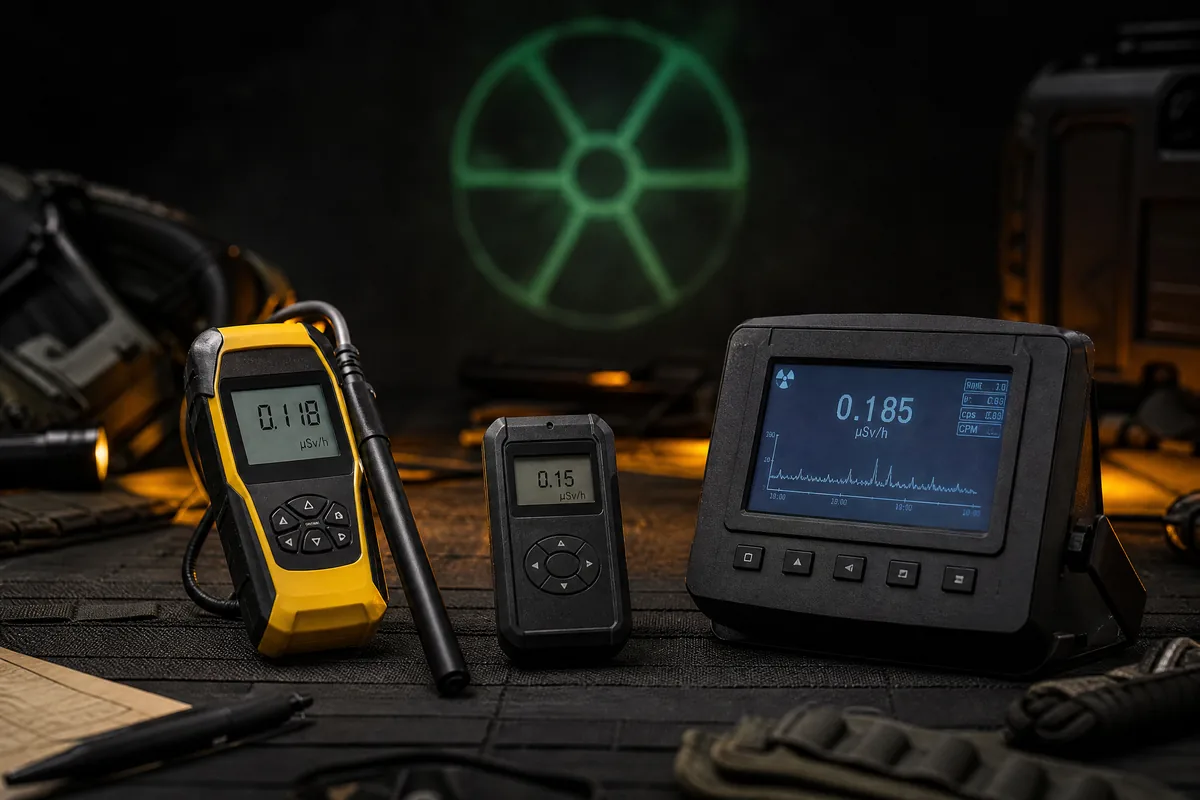
A Geiger counter is the single most important piece of equipment in a nuclear preparedness kit — more important than food, water filters, or even potassium iodide — because without it, you cannot make a single rational decision after a nuclear event. You cannot know when to leave shelter, whether your water is safe to drink, whether the food in your pantry is contaminated, or whether the route you plan to drive passes through a dangerous fallout zone. Every other preparedness decision depends on radiation data, and a Geiger counter is the only tool that provides it.
The problem is that the civilian Geiger counter market is flooded with cheap, unreliable devices that look impressive on Amazon but fail precisely when you need them most — in high-radiation environments. This guide evaluates the top five models available in 2026 based on four criteria that matter for nuclear preparedness: measurement range (can it read the high levels present in fallout zones without saturating?), detector type (does it detect alpha and beta in addition to gamma?), battery life, and ease of use under stress. All specifications are sourced from official manufacturer product pages and user manuals (links provided for each model) and cross-referenced against NRC calibration standards. Nuclear Ready has not independently tested these devices.
Geiger Counter vs. Dosimeter: What You Actually Need
A Geiger counter, as defined by the National Council on Radiation Protection and Measurements (NCRP), is an active radiation detection instrument that measures instantaneous dose rate — the amount of ionizing radiation passing through the detector at any given moment, expressed in units of mR/hr, μSv/hr, or counts per minute (CPM). It answers the question: how much radiation is here right now?
A dosimeter is a separate instrument that measures cumulative radiation dose — the total amount of radiation your body has absorbed over a period of time, expressed in mSv or rem. It answers the question: how much radiation have I received in total? For nuclear preparedness, you need both. The Geiger counter tells you whether it is safe to exit your shelter at any given moment. The dosimeter tells you whether you have already absorbed enough radiation to require medical attention, regardless of current conditions.
A third category — the personal radiation detector (PRD) — is a simplified alarm device that beeps when radiation exceeds a preset threshold. PRDs are useful as a first-alert system but do not provide the quantitative measurements needed for shelter-in-place decisions. They are not a substitute for a proper Geiger counter in a nuclear preparedness context.
What to Look for in a Nuclear Preparedness Geiger Counter
The most critical specification for nuclear preparedness use is measurement range. Most consumer Geiger counters are designed for low-level radiation monitoring (checking food for Fukushima contamination, measuring radon in homes) and have a maximum range of 1–10 mSv/hr. In a nuclear fallout scenario, radiation levels near a detonation can reach thousands of mSv/hr in the first hours. A device that saturates at 1 mSv/hr will simply display its maximum reading — giving you no useful information about how dangerous your environment actually is.
The second critical specification is detector type. A standard side-window Geiger-Müller tube detects gamma rays and high-energy beta particles. A pancake probe (end-window GM tube) additionally detects alpha particles and low-energy beta, which is important for detecting surface contamination on food, water containers, and skin. For comprehensive fallout detection, a pancake probe is strongly preferred.
| Model | Max Range | Detector Type | Display | Battery Life | Price (2026) | Best For |
|---|---|---|---|---|---|---|
| GQ GMC-800 ⭐ | 1,000 mSv/hr | Pancake probe (α/β/γ) | LCD + USB data | ~150 hrs | ~$85–$95 | Best overall |
| Better Geiger S2 | 100 mSv/hr (Cs-137) | Side-window (β/γ) | OLED + app | ~80 hrs | ~$120–$140 | Highest range |
| Radex RD1212 | 999 μSv/hr (≈1 mSv/hr) | SBM-20 (β/γ) | LCD | ~1,000 hrs | ~$55–$65 | Best budget |
| Terra-P+ | 3 mSv/hr | SBM-20 (β/γ) | LCD | ~500 hrs | ~$130–$150 | Reliability/longevity |
| Mazur PRM-9000 | 125 mR/hr (1,250 μSv/hr) | Pancake probe (α/β/γ) | LCD + USB data | ~200 hrs | ~$350–$400 | Professional accuracy |
The 5 Best Geiger Counters for Civilians in 2026
1. GQ GMC-800 — Best All-Around Nuclear Preparedness Geiger Counter
The GQ GMC-800 is the strongest value proposition in civilian nuclear preparedness for 2026. Its combination of a high measurement range, USB data logging, and sub-$100 price makes it the default recommendation for anyone building a nuclear preparedness kit from scratch. Official product page →
✓ Pros
- Pancake probe detects alpha, beta, and gamma — essential for surface contamination checks
- 1,000 mSv/hr range won't saturate in heavy fallout zones
- USB data logging lets you track radiation trends over time
- Standard AA batteries — easy to stockpile and replace
- Active community with firmware updates and calibration guides
✗ Cons
- Accuracy is ±15% — acceptable for preparedness but not laboratory-grade
- Interface requires some learning; not intuitive under stress
- Pancake probe is fragile — needs a protective case
Nuclear preparedness verdict: The GMC-800 is the correct choice for 90% of civilians. Its 1,000 mSv/hr range covers all realistic fallout scenarios, and the pancake probe allows you to check food, water, and surfaces for contamination — a capability that cheaper side-window models lack.
2. Better Geiger S2 — Best for High-Radiation Environments
The Better Geiger S2 uses a scintillator detector (not a traditional Geiger tube), which provides better accuracy at high radiation levels. Its 100 mSv/hr maximum range and energy-corrected dose rate make it the most capable civilian device in this guide for fallout monitoring. Official specs →
✓ Pros
- 100 mSv/hr continuous range — won't saturate in any realistic civilian fallout scenario
- Bluetooth app provides graphing, data export, and dose rate history
- Compact and lightweight — fits in a shirt pocket
- Fast response time (~3 seconds) for real-time monitoring while moving
✗ Cons
- No pancake probe — cannot detect alpha particles or surface contamination
- Rechargeable battery requires power access; no AA fallback
- App dependency is a vulnerability if phone is damaged or dead
Nuclear preparedness verdict: Best choice if you live within 50 miles of a nuclear target and want the highest-range device available. Pair it with a GQ GMC-800 for surface contamination checks.
3. Radex RD1212 — Best Under $65 for Basic Fallout Monitoring
The Radex RD1212 is the most reliable budget Geiger counter for basic nuclear preparedness. Its 1,000-hour battery life is unmatched — a critical advantage in a post-event scenario where power may be unavailable for weeks. The trade-off is a limited 1 mSv/hr maximum range, which will saturate in heavy fallout conditions.
✓ Pros
- ~1,000-hour battery life — exceptional for extended shelter-in-place scenarios
- Simple, intuitive interface — easy to use under stress
- Proven reliability: used by Chernobyl liquidators and Fukushima responders
- Audible alarm for threshold detection without watching the display
✗ Cons
- 1 mSv/hr maximum — will saturate and display "OVER" in heavy fallout
- No alpha detection — cannot check surface contamination comprehensively
- No data logging or connectivity
Nuclear preparedness verdict: Adequate for monitoring radiation levels after the initial fallout peak has passed (24–72 hours post-detonation, when levels typically drop below 1 mSv/hr). Not suitable for monitoring in the first hours after a detonation near a target zone.
4. Terra-P+ — Best for Long-Term Reliability
The Terra-P+ is a Ukrainian-manufactured Geiger counter with a decades-long track record in post-Soviet nuclear monitoring programs. Its build quality and reliability are exceptional, though its 3 mSv/hr maximum range limits its usefulness in high-fallout scenarios.
✓ Pros
- Ruggedized construction — survives drops, dust, and moisture
- Factory-calibrated with NIST-traceable sources
- Proven in real-world nuclear monitoring environments (Chernobyl exclusion zone)
✗ Cons
- 3 mSv/hr range is insufficient for monitoring in the first 24 hours post-detonation
- Higher price than the GMC-800 for less range capability
- Availability may be limited due to supply chain disruptions in 2026
5. Mazur PRM-9000 — Best Professional-Grade Option
The Mazur PRM-9000 is the most accurate civilian Geiger counter available, with a calibration accuracy of ±10% typical (±15% maximum) and a 125 mR/hr (1,250 μSv/hr) measurement range. Official specs → Its price puts it out of reach for most civilians, but for those who want professional-grade accuracy — first responders, medical professionals, or serious preppers — it is the definitive choice.
✓ Pros
- ±10% accuracy — the highest of any civilian device in this guide
- Pancake probe + 1,000 mSv/hr range: the complete package
- Professional data logging software included
✗ Cons
- $350–$400 price is prohibitive for most households
- 9V battery is less convenient to stockpile than AA
- Overkill for basic shelter-in-place monitoring
How to Read Geiger Counter Values in a Nuclear Emergency
Understanding Geiger counter readings in the context of a nuclear emergency requires knowing two things: the unit of measurement your device uses, and the FEMA/NRC thresholds that define safe, caution, and dangerous radiation levels. The table below provides a practical reference for shelter-in-place decision-making, based on FEMA Nuclear Detonation Response Guidance (FEMA-654) and NCRP Report No. 138.
| Reading (mR/hr) | Reading (μSv/hr) | Reading (mSv/hr) | Status | Action (FEMA) |
|---|---|---|---|---|
| 0.01–0.03 | 0.1–0.3 | 0.0001–0.0003 | SAFE | Normal background — no action needed |
| 0.03–2 | 0.3–20 | 0.0003–0.02 | SAFE | Slightly elevated — monitor; shelter-in-place optional |
| 2–100 | 20–1,000 | 0.02–1 | CAUTION | Remain sheltered; limit outdoor time to minutes |
| 100–1,000 | 1,000–10,000 | 1–10 | DANGER | Do not exit shelter; radiation hazard within hours |
| 1,000–10,000 | 10,000–100,000 | 10–100 | LETHAL | Lethal exposure within 1–2 hours — absolute shelter required |
| >10,000 | >100,000 | >100 | EXTREME | Lethal within minutes — do not exit under any circumstances |
Sources: FEMA Nuclear Detonation Response Guidance (FEMA-654); NCRP Report No. 138; NRC Radiation Dose Standards. Values are approximate and depend on exposure duration, shielding, and individual health factors.
The key practical insight from this table is the 2 mR/hr threshold: FEMA guidance indicates that when outdoor Geiger counter readings drop below approximately 2 mR/hr (0.02 mSv/hr), brief outdoor activity — such as moving to a better shelter or retrieving supplies — becomes generally acceptable. Per the 7/10 Rule, this level is typically reached 24–72 hours after a detonation for most locations outside the immediate blast zone.
Geiger Counter Unit Conversion Reference
Geiger counters display radiation measurements in a variety of units depending on the manufacturer and model. The following conversion table allows you to translate between the most common units used in civilian devices, FEMA guidance documents, and NRC regulatory standards.
| From | To μSv/hr | To mR/hr | To R/hr | To mSv/hr |
|---|---|---|---|---|
| 1 μSv/hr | — | 0.1 mR/hr | 0.0001 R/hr | 0.001 mSv/hr |
| 1 mR/hr | 10 μSv/hr | — | 0.001 R/hr | 0.01 mSv/hr |
| 1 R/hr | 10,000 μSv/hr | 1,000 mR/hr | — | 10 mSv/hr |
| 1 mSv/hr | 1,000 μSv/hr | 100 mR/hr | 0.1 R/hr | — |
| 100 CPM (SBM-20) | ~1 μSv/hr | ~0.1 mR/hr | ~0.0001 R/hr | ~0.001 mSv/hr |
Note: CPM conversion is approximate and varies by detector tube type. The SBM-20 conversion factor (~100 CPM per μSv/hr for Cs-137 gamma) is a commonly used approximation. Consult your device's manual for the exact calibration factor.
Frequently Asked Questions
For civilian nuclear preparedness in 2026, the best overall Geiger counter is the GQ GMC-800 (under $100, measures up to 1,000 mSv/hr, includes a pancake probe for alpha/beta/gamma detection). For the highest measurement range needed in a nuclear emergency — up to 100 mSv/hr continuous and 1,000 mSv/hr peak — the Better Geiger S2 is the top choice. The Radex RD1212 is the best budget option under $65 for basic gamma/X-ray detection. All three are NRC-compatible and suitable for civilian shelter-in-place monitoring.
A Geiger counter is an active radiation detector that measures the current radiation rate (dose rate) in real time, expressed in mR/hr, μSv/hr, or CPM. It tells you how much radiation is present right now. A dosimeter is a passive or electronic device that measures your cumulative radiation exposure over time, expressed in mSv or rem. For nuclear preparedness, you need both: a Geiger counter to decide when it is safe to leave shelter (based on current dose rate), and a dosimeter to track your total accumulated exposure and avoid exceeding safe lifetime limits.
According to NRC and FEMA guidance: background radiation is typically 0.1–0.3 μSv/hr (0.01–0.03 mR/hr). A reading above 1 mSv/hr (100 mR/hr) indicates elevated radiation requiring immediate shelter. A reading above 10 mSv/hr (1,000 mR/hr) is a serious hazard — limit exposure to minutes. A reading above 100 mSv/hr (10,000 mR/hr) is immediately dangerous — do not exit shelter. FEMA's shelter-in-place guidance states that it is generally safe to briefly exit shelter when outdoor readings drop below 2 mR/hr (0.02 mSv/hr), which typically occurs 24–72 hours after a detonation per the 7/10 Rule.
Yes — a Geiger counter is the primary tool for detecting nuclear fallout. Fallout consists primarily of gamma-emitting radioactive isotopes (such as Cesium-137, Iodine-131, and Strontium-90) that are easily detected by any standard Geiger-Müller tube. For the most comprehensive fallout detection, choose a model with a pancake probe (end-window GM tube), which also detects alpha and beta particles in addition to gamma radiation. Models with only a standard side-window tube will detect gamma and some beta, but may miss alpha contamination on surfaces.
Yes — fallout from a nuclear detonation can travel hundreds of miles downwind within hours. According to FEMA's nuclear detonation response guidance, significant fallout can reach areas 200–300 miles from the detonation point within 12–24 hours, depending on wind speed and direction. A Geiger counter allows you to monitor radiation levels at your location, determine when it is safe to exit shelter, and detect contamination on food, water, and surfaces — regardless of how far you are from the original detonation.
The most common unit conversions: 1 mSv/hr = 100 mR/hr = 0.1 R/hr. 1 R/hr = 10 mSv/hr = 1,000 mR/hr. 1 μSv/hr = 0.1 mR/hr = 0.0001 R/hr. For CPM (counts per minute), the conversion depends on the specific detector tube efficiency, but a rough approximation for Cs-137 gamma is: 1 μSv/hr ≈ 100–120 CPM for a standard SBM-20 tube. Always check your specific model's calibration factor in the manual for accurate conversions.
DISCLAIMER
Product specifications and prices are based on publicly available data as of July 2026 and may change. Nuclear Ready does not sell, manufacture, or endorse any specific product. All specifications in this guide are sourced from official manufacturer documentation and have not been independently tested by Nuclear Ready. Verify current specifications directly with manufacturers before purchasing. Always verify current specifications with the manufacturer before purchase. Radiation safety decisions should follow official guidance from FEMA, NRC, and local emergency management authorities.