How to Purify Water After Nuclear Fallout: Storage & Filtration Guide
Key Takeaways
- 1 Gallon Per Person Per Day is the FEMA minimum standard for emergency water storage — store at least 14 gallons per adult for a 14-day shelter period.
- Boiling Water Does NOT Remove Radiation. It kills bacteria, but it concentrates radioactive isotopes. Never boil water you suspect is radiologically contaminated.
- Tap water inside closed pipes is initially safe after a detonation, but wait for official utility confirmation before using it.
- Reverse osmosis (RO) filters are the only consumer-grade technology proven to remove radioactive isotopes like cesium-137 and strontium-90.
- Standard camping filters (LifeStraw, Sawyer, Berkey) are not rated for radiological contamination and should not be used as a primary water source after fallout.
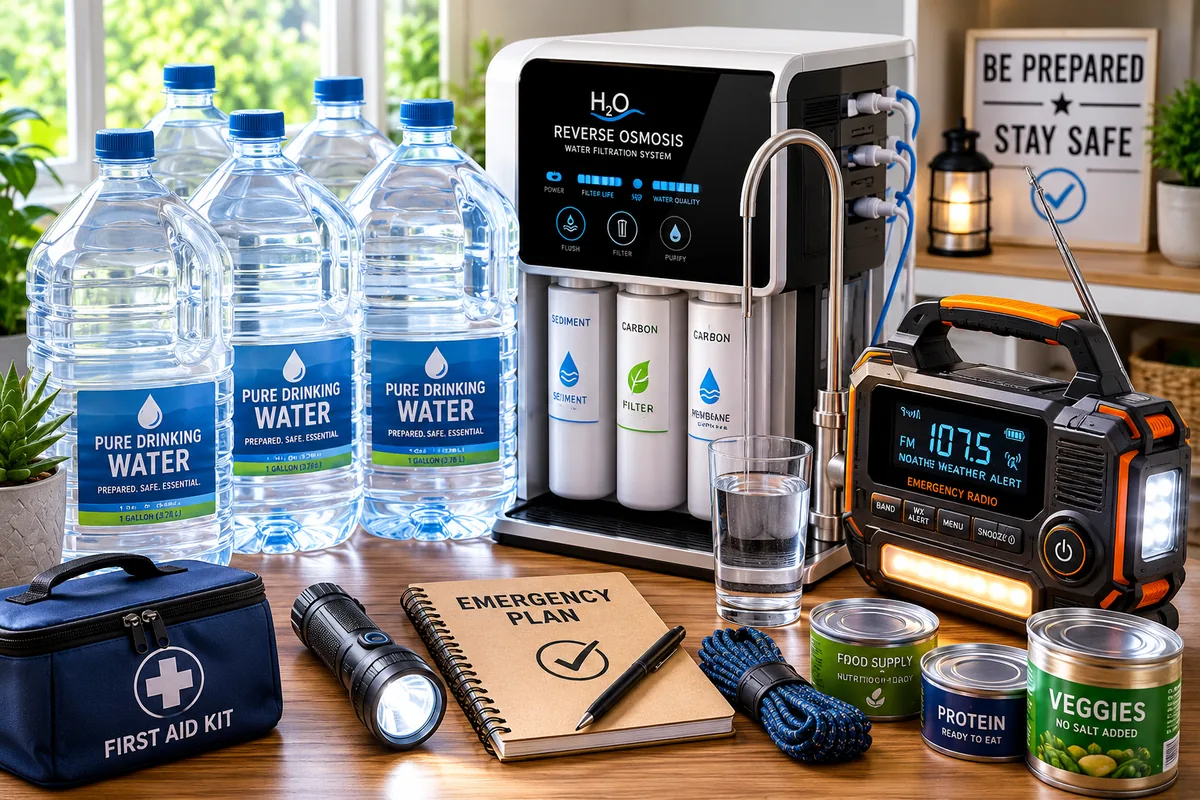
Table of Contents
How Much Water Per Person for a Nuclear Emergency?
The Federal Emergency Management Agency (FEMA) recommends storing a minimum of one gallon of water per person per day for emergency preparedness. For a nuclear fallout scenario, the standard planning period is 14 days of shelter-in-place — meaning each adult in your household requires at least 14 gallons of sealed, stored water. A family of four needs a minimum of 56 gallons, and that figure covers only drinking and essential sanitation. If you have infants, elderly family members, or anyone with a medical condition that increases fluid requirements, plan for significantly more.
The one-gallon figure is a survival floor, not a comfort standard. In practice, water is consumed faster than most people expect during an emergency: cooking, basic hygiene, wound care, and the physical stress of a crisis all increase consumption. FEMA and the CDC's radiation emergency guidance both recommend storing water in food-grade, sealed containers — ideally commercially bottled water, which carries a guaranteed seal date. If you are filling your own containers, use food-grade plastic (HDPE, marked with a #2 recycling symbol), clean them thoroughly with diluted bleach, and store them away from direct sunlight in a cool, dark location. Rotate your supply every 6 to 12 months.
Official Source: "Store at least one gallon of water per person per day for several days, for drinking and sanitation." — FEMA Ready.gov — Water
Can You Drink Tap Water During Nuclear War?
Water that is already inside a closed municipal plumbing system at the moment of a nuclear detonation is generally considered safe to consume in the immediate aftermath. The reason is straightforward: the pipes physically shield the water from fallout particles, which are deposited on open surfaces, not inside sealed infrastructure. This is an important distinction — the danger from fallout contamination comes from radioactive particles settling on open water sources (lakes, rivers, reservoirs, and rain), not from water that was already enclosed in pipes when the detonation occurred.
However, this safety window is conditional and time-limited. Municipal water treatment plants draw from surface reservoirs and open water sources that will become contaminated as fallout settles. Once a treatment plant processes contaminated source water and distributes it through the system, tap water becomes unsafe. For this reason, you should not use tap water after a nuclear event until local utility authorities or emergency management officials explicitly confirm that the water supply is unaffected. In the absence of official guidance, treat your pre-stored sealed water as your only safe source and do not open taps, flush toilets unnecessarily, or use water from any source that has not been confirmed safe. See our nuclear survival kit guide for the complete list of water storage and filtration equipment to have on hand before an emergency.
The Big Myth: Does Boiling Water Remove Radiation?
This is one of the most dangerous misconceptions in nuclear preparedness, and it is critically important to understand: boiling water does not remove radioactive contamination. Boiling is highly effective at killing biological pathogens — bacteria, viruses, and parasites — but radioactive isotopes are not living organisms. They are atoms. Heat has no effect on their radioactive properties. When you boil water that contains radioactive particles such as cesium-137, strontium-90, or iodine-131, you are evaporating the water molecules while the radioactive atoms remain in the pot. The result is a smaller volume of water with a higher concentration of radiation than you started with.
The practical implication is stark: if you suspect your water source has been contaminated by nuclear fallout, boiling it will make the situation worse, not better. This applies to all heat-based treatment methods, including distillation at the household level — unless you are using a properly designed distillation apparatus that captures and discards the initial distillate. The only reliable consumer-grade methods for removing radioactive isotopes from water are reverse osmosis filtration and ion-exchange resins, both of which physically trap or chemically bind the radioactive atoms rather than attempting to destroy them with heat. Chemical disinfection tablets (iodine, chlorine) are also ineffective against radiation for the same reason — they target biological contamination, not atomic particles. For more on what to take during a nuclear emergency, see our guide on potassium iodide (KI) dosage and timing.
Key Fact: Boiling concentrates radioactive isotopes. The CDC and EPA both confirm that standard water treatment methods — including boiling, chlorination, and UV treatment — do not remove radioactive contamination. Only physical filtration (reverse osmosis) or ion exchange is effective. — EPA: Radiation and Drinking Water
How to Purify Water After Nuclear Fallout
Reverse osmosis (RO) is the gold standard for removing radioactive contamination from water at the household level. An RO system forces water through a semi-permeable membrane with pores small enough to block dissolved ions, including radioactive isotopes like cesium-137 (ionic radius ~1.7 Å) and strontium-90. According to the U.S. Environmental Protection Agency, reverse osmosis can remove 85–95% of radioactive contaminants from water, depending on the specific isotope and system design. Under-sink RO units are available for permanent installation, and countertop RO systems provide a portable option for emergency use. For a nuclear preparedness kit, a countertop RO unit with a sufficient membrane and pre-filter set is one of the highest-value investments you can make. Ion-exchange filters are a complementary technology: they use charged resin beads that chemically bind radioactive cations (positively charged ions like cesium and strontium), effectively pulling them out of the water. Some high-end water filtration systems combine RO membranes with ion-exchange stages for maximum effectiveness.
It is equally important to understand what does not work. Standard portable camping filters — including popular brands like LifeStraw, Sawyer Squeeze, and even gravity-fed Berkey filters — are designed to remove biological pathogens and some chemical contaminants. Their filter media (hollow fiber membranes, activated carbon) are not rated for radiological contamination and will not reliably remove radioactive isotopes. UV purification pens (SteriPen and similar) kill bacteria and viruses with ultraviolet light but have zero effect on dissolved radioactive atoms. Chemical treatment tablets (iodine, sodium hypochlorite) are similarly ineffective against radiation. In a post-fallout environment, relying on any of these methods as your primary water treatment strategy is a serious error. If you do not have access to an RO system, your safest option is to use only pre-stored sealed water until official authorities confirm that a safe water supply has been restored.
Frequently Asked Questions
Complete Your Preparedness
Nuclear Survival Kit Essentials: The Complete Checklist →Water is only one piece of the puzzle. This guide covers all 17 essential items for a complete nuclear survival kit — including dosimetry, shelter supplies, food, and communication gear.
Radiation Protection
Potassium Iodide (KI) Dosage Guide: When and How to Take It →KI tablets protect your thyroid from radioactive iodine-131 — one of the most common isotopes released in a nuclear event. Learn the exact dosage by age, timing, and when NOT to take it.