
Nuclear Winter Survival Guide 2026: Food, Farming & Long-Term Preparedness
Key Takeaways
- Duration: 2–5 years (limited conflict) to 5–15 years (full US-Russia exchange), based on Coupe & Robock (2019), JGR Atmospheres.
- Primary threat is famine, not radiation — Xia et al. (2022) in Nature Food estimate that nuclear winter-induced crop failure could kill more people than the initial blasts and fallout combined: over 2 billion from an India-Pakistan exchange, over 5 billion from a US-Russia exchange.
- Minimum food reserve recommended: 2 years of caloric supply per person (~1.46 million calories = ~730 lbs of white rice equivalent), based on the famine timeline modeled by Xia et al. (2022).
- Crops that survive: Potatoes, winter rye, turnips, beets, mushrooms, and sprouts can all be grown in low-light, cold conditions — the key to long-term survival beyond your initial stockpile.
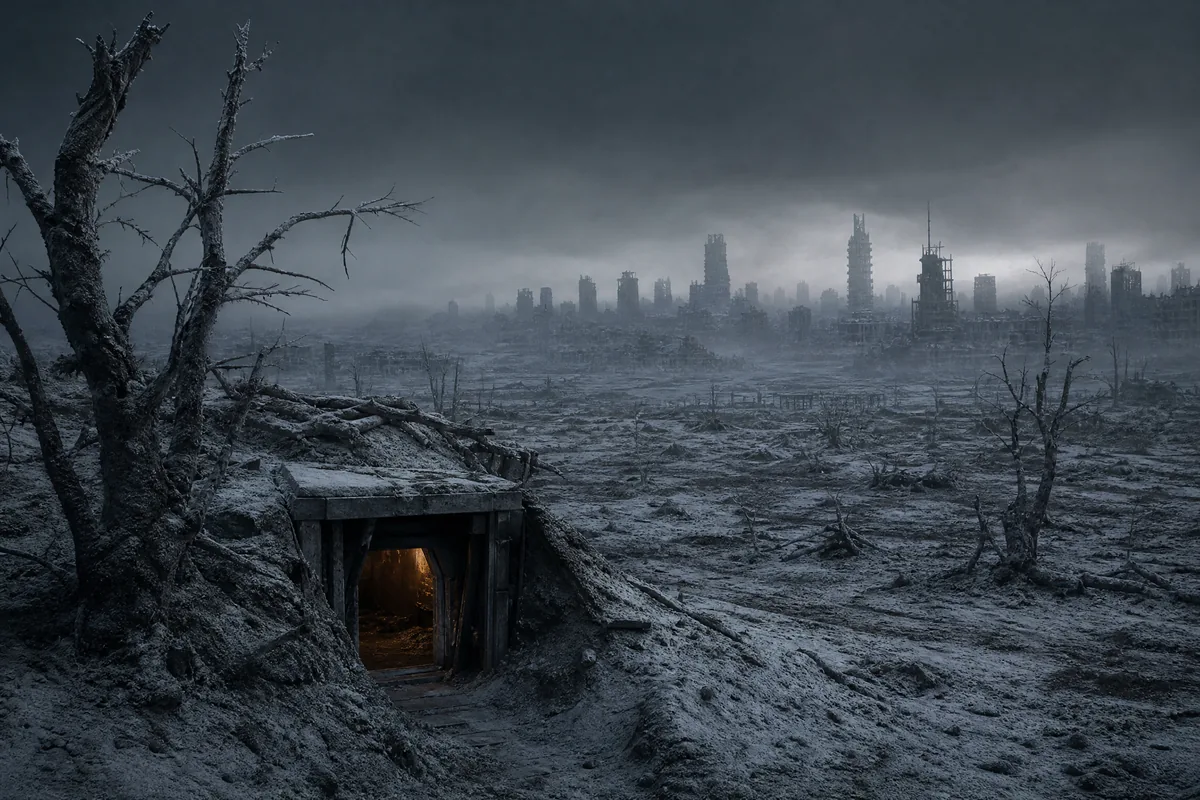
Nuclear winter is the long-term climatic effect of a large-scale nuclear war — the phenomenon that most preparedness guides ignore entirely, yet which climate scientists now consider the most catastrophic consequence of nuclear conflict. The immediate effects of nuclear weapons — blast, heat, and radiation — kill millions in the first hours. Nuclear winter kills billions over the following years through crop failure, famine, and the collapse of global food systems.
The landmark 2022 study by Xia, Robock et al. published in Nature Food — the most comprehensive nuclear winter food security analysis to date, with 350+ academic citations — found that even a limited regional nuclear conflict involving 100 Hiroshima-sized weapons could reduce global food production by 7–50% for 2–5 years. A full-scale US-Russia strategic exchange could reduce Northern Hemisphere growing seasons to near zero for a decade. The climate modeling underpinning these estimates comes from Coupe, Bardeen, Robock & Toon (2019) using the WACCM4 model. This guide translates that peer-reviewed science into actionable preparedness steps: what to stockpile, what to grow, and how to plan for long-term survival when global agriculture fails.
What Is Nuclear Winter?
Nuclear winter is a severe global cooling event caused by the injection of massive quantities of soot and smoke into the stratosphere following the firestorms ignited by nuclear weapons detonated over cities. Unlike volcanic eruptions, which inject sulfur dioxide into the lower stratosphere where it is washed out by rain within 1–2 years, nuclear firestorm soot reaches the upper stratosphere (25–80 km altitude) where it can persist for 5–15 years, continuously absorbing and blocking incoming solar radiation.
The mechanism was first modeled by Turco, Toon, Ackerman, Pollack, and Sagan (TTAPS) in their landmark 1983 Science paper. Subsequent modeling by Coupe, Bardeen, Robock & Toon (2019) in the Journal of Geophysical Research: Atmospheres refined the estimates significantly using the WACCM4 climate model — the most comprehensive nuclear winter simulation to date. The 2022 food security study by Xia, Robock et al. in Nature Food (350+ citations) extended this work to quantify famine deaths for six nuclear war scenarios. The core finding has remained consistent across 40 years of research: even a fraction of the world's nuclear arsenal, if used against cities, is sufficient to trigger a multi-year global cooling event that would devastate global agriculture.
Nuclear Winter Scenarios: Duration and Severity
The severity of nuclear winter scales with the number of weapons detonated over urban and industrial targets, the total yield, and the flammability of the targeted cities. The 2025 Penn State/Columbia climate model identifies three primary scenarios relevant to current geopolitical risks.
Scenario A: Limited Regional Conflict — "Nuclear Autumn"
Example: India-Pakistan nuclear exchange (~100 Hiroshima-sized weapons, 15 kt each) — Scenario 3 in Xia et al. (2022), Nature Food
| Parameter | Value |
|---|---|
| Soot injected into stratosphere | ~5 Tg (5 million metric tons) |
| Global average temperature drop | 1–3°C (Northern Hemisphere: 2–5°C) |
| Sunlight reduction | 10–20% |
| Growing season reduction | 10–30 days shorter per year |
| Duration of effects | 2–5 years |
| Global food production impact | 7–20% reduction |
| Estimated famine deaths | 500 million – 2 billion (indirect) |
Scenario B: Full US-Russia Strategic Exchange — "Nuclear Winter"
Example: Large-scale US-Russia exchange (~4,000 strategic warheads, 100–800 kt each) — 150 Tg scenario in Coupe & Robock (2019), JGR Atmospheres
| Parameter | Value |
|---|---|
| Soot injected into stratosphere | 150–180 Tg |
| Global average temperature drop | 8–15°C (Northern Hemisphere: 10–25°C) |
| Sunlight reduction | 40–70% |
| Growing season reduction | Near-complete elimination for 5–10 years |
| Duration of effects | 5–15 years |
| Global food production impact | 50–90% reduction |
| Estimated famine deaths | 3–5 billion (indirect) |
Sources: Coupe & Robock (2019), JGR Atmospheres; Xia et al. (2022), Nature Food. Famine death estimates carry significant uncertainty and represent model projections, not predictions.
Food Stockpile for Nuclear Winter: What to Buy Now
A food stockpile for nuclear winter preparedness must meet three criteria: maximum caloric density per unit of storage space, maximum shelf life (10–30 years), and nutritional completeness to prevent deficiency diseases during extended storage periods. The following table provides a practical shopping list based on FEMA's long-term emergency food guidance (fema.gov/emergency-managers/national-preparedness) and peer-reviewed food security research.
The baseline calculation is 2,000–2,500 calories per adult per day for a minimum 2-year reserve. For a family of four (2 adults, 2 children), this requires approximately 5.8–7.3 million calories total — achievable with roughly 2,900–3,650 lbs of mixed dry staple foods.
| Food Item | Shelf Life (sealed) | Cal/lb | Cal/$ (approx.) | Notes |
|---|---|---|---|---|
| White rice | 25–30 years | ~1,640 | High | Best calorie-per-dollar; store in Mylar bags with O2 absorbers in 5-gal buckets |
| Hard red winter wheat | 25–30 years | ~1,500 | High | Requires grain mill; more nutritious than white flour |
| Dried pinto/black beans | 25–30 years | ~1,550 | High | Essential protein source; pair with grains for complete amino acid profile |
| Dried lentils | 25 years | ~1,560 | High | Cook faster than beans; high iron and folate |
| Rolled oats | 20–30 years | ~1,800 | High | High fiber; good for breakfast rotation |
| Pasta (dry) | 25–30 years | ~1,680 | High | Sealed in Mylar; easy to prepare with minimal fuel |
| Cooking oil (coconut/palm) | 2–5 years | ~3,500 | Medium | Highest caloric density; rotate stock; essential for fat intake |
| Honey | Indefinite | ~1,380 | Low | Antimicrobial; caloric sweetener; medicinal uses |
| Salt | Indefinite | 0 | N/A | Essential for food preservation and electrolyte balance; store 5–10 lbs per person |
| Freeze-dried vegetables | 25–30 years | ~200–400 | Low | Critical for vitamin C, A, K; prevents scurvy and deficiency diseases |
| Multivitamins | 2–5 years | N/A | N/A | Rotate stock; essential to prevent deficiency diseases during monotonous diet |
| Canned fish (tuna/salmon) | 3–5 years | ~800 | Medium | Omega-3s; complete protein; rotate stock every 3–5 years |
| Powdered milk | 20–25 years | ~1,600 | Medium | Calcium source; essential for children; store in sealed containers |
| Baking soda & powder | Indefinite / 1 year | 0 | N/A | Essential for bread-making from stored grains |
Farming During Nuclear Winter: What Can Grow
Indoor and low-light farming is the critical bridge between your initial food stockpile and long-term self-sufficiency during nuclear winter. The key insight from agricultural research on nuclear winter scenarios is that not all crops fail equally. Cold-tolerant, low-light crops can continue to produce food even in the reduced sunlight and temperature conditions of a nuclear autumn or mild nuclear winter scenario.
Long-Term Water Supply During Nuclear Winter
Water security during nuclear winter is complicated by two factors: the potential for radioactive contamination of surface water in the immediate post-war period, and the long-term disruption of municipal water infrastructure. The following strategy addresses both phases.
- Phase 1 (0–6 months post-detonation): Use only stored water or water from deep wells (100+ feet). Surface water (rivers, lakes, ponds) may be contaminated with radioactive fallout. Filter all water through a multi-stage system: sediment pre-filter → activated carbon filter → reverse osmosis or distillation. See our Nuclear Fallout Water Purification guide for detailed protocols.
- Phase 2 (6 months – 2 years): Radioactive contamination of surface water decreases significantly as short-lived isotopes decay. Continue filtering. Deep well water is generally safe. Rainwater collection becomes viable once fallout has settled and rain has washed the atmosphere (typically 1–3 months post-detonation).
- Phase 3 (2+ years): Surface water is generally safe from radioactive contamination. Primary concern shifts to biological contamination (bacteria, parasites) from collapsed sanitation infrastructure. Standard filtration and purification methods (boiling, chlorination) are sufficient.
- Minimum storage: 1 gallon per person per day for drinking and cooking. Store at least 30 days' supply (30 gallons per person) in sealed food-grade containers.
Safest Regions to Survive Nuclear Winter
Geographic location is one of the most important factors in nuclear winter survival, because the climatic effects are not distributed equally around the globe. The 2025 Penn State/Columbia climate model identifies significant regional variation in temperature drop and sunlight reduction, driven primarily by the location of nuclear targets (concentrated in the Northern Hemisphere) and atmospheric circulation patterns.
| Region | Temp Drop (Full Exchange) | Sunlight Reduction | Growing Season Impact | Relative Safety |
|---|---|---|---|---|
| Northern Russia / Canada interior | 15–25°C below normal | 50–70% | Near-complete failure | Extreme risk |
| Northern Europe / UK | 10–18°C below normal | 40–60% | Severe failure | Very high risk |
| Northern US / Great Plains | 8–15°C below normal | 35–55% | Severe failure | Very high risk |
| Southern US / Mediterranean | 4–8°C below normal | 20–35% | Significant reduction | High risk |
| Central America / Caribbean | 2–5°C below normal | 15–25% | Moderate reduction | Moderate risk |
| Southern Brazil / Argentina | 1–3°C below normal | 10–20% | Minor reduction | Lower risk |
| Australia / New Zealand | 0.5–2°C below normal | 5–15% | Minimal impact | Lowest risk |
Sources: Coupe & Robock (2019); Xia et al. (2022). Values are approximate model projections for the 150 Tg soot scenario and carry significant uncertainty. Actual impacts depend on war scale, targeting, and seasonal timing.
Frequently Asked Questions
The duration of nuclear winter depends heavily on the scale of the nuclear exchange. According to peer-reviewed climate modeling by Coupe, Bardeen, Robock & Toon (2019) in the Journal of Geophysical Research: Atmospheres, a limited regional nuclear conflict (e.g., India-Pakistan, ~100 Hiroshima-sized weapons) could produce a nuclear autumn lasting 2–5 years, with global average temperature drops of 1–3°C. A large-scale US-Russia strategic exchange (thousands of warheads) could produce a full nuclear winter lasting 5–15 years, with temperature drops of 8–15°C in the Northern Hemisphere and catastrophic reductions in sunlight and growing seasons for a decade or more.
For nuclear winter preparedness, prioritize calorie-dense, long-shelf-life foods: white rice (25–30 year shelf life in sealed containers), hard red winter wheat (25+ years), dried beans and lentils (25+ years), freeze-dried vegetables and fruits (25–30 years), canned meats and fish (3–5 years), cooking oils (2–5 years), salt, sugar, and honey (indefinite). Based on the famine timeline modeled by Xia et al. (2022) in Nature Food, a minimum 2-year caloric reserve per person is a reasonable baseline for a serious nuclear winter scenario. Calculate 2,000–2,500 calories per adult per day.
Yes, but with significant limitations. During nuclear winter, reduced sunlight (20–70% reduction depending on scenario) and lower temperatures severely limit conventional agriculture. Crops that can survive in low-light, cold conditions include: potatoes (cold-tolerant, high caloric yield per square foot), winter rye and barley (frost-tolerant grains), root vegetables like turnips, beets, and carrots (cold-hardy), mushrooms (grow in darkness, no sunlight required), and sprouts from stored seeds (can be grown indoors with minimal light). Indoor growing under artificial light (LED grow lights powered by stored fuel or solar) is the most reliable food production strategy during the first 1–3 years.
The safest regions for surviving nuclear winter are those in the Southern Hemisphere, particularly Australia, New Zealand, Argentina, and southern Brazil. According to Coupe & Robock (2019), the Southern Hemisphere experiences significantly less temperature drop and sunlight reduction than the Northern Hemisphere in most nuclear war scenarios, because most nuclear targets and soot-producing fires are concentrated in the Northern Hemisphere. Within the Northern Hemisphere, coastal regions at lower latitudes (southern US, Mediterranean, southern China) fare better than continental interiors at high latitudes.
Temperature drops during nuclear winter vary by scenario and location. According to Coupe, Bardeen, Robock & Toon (2019) using the WACCM4 climate model: a limited conflict (100 weapons) causes average Northern Hemisphere temperature drops of 1–3°C, with some continental interiors dropping 5–10°C in summer. A full US-Russia exchange (4,000+ weapons) causes average Northern Hemisphere drops of 8–15°C, with continental interiors potentially dropping 20–30°C below normal summer temperatures — effectively eliminating the growing season in most of North America, Europe, and Russia for 5–10 years.
Based on the famine duration modeled by Xia et al. (2022) in Nature Food, storing a minimum of 2 years of food per person is a reasonable baseline for serious nuclear winter preparedness. At 2,000 calories per day per adult, this requires approximately 1.46 million calories per person — roughly 730 lbs (330 kg) of white rice, or an equivalent combination of grains, legumes, and fats. For a family of four, this means approximately 2,920 lbs (1,325 kg) of dry staple foods, stored in food-grade sealed containers in a cool, dark location. This does not account for the possibility of supplementing with indoor gardening, which can reduce the required stockpile.
DISCLAIMER & SOURCES
This guide is for educational and preparedness purposes only. Climate model projections for nuclear winter carry significant uncertainty. The scenarios described are based on peer-reviewed research, not predictions. Primary sources: Xia, Robock et al. (2022), Nature Food (food insecurity modeling); Coupe, Bardeen, Robock & Toon (2019), JGR Atmospheres (WACCM4 climate model); Turco, Toon, Ackerman, Pollack & Sagan (1983), Science (TTAPS original study). Nuclear Ready is not affiliated with any government agency or academic institution. Always consult official emergency management guidance for preparedness planning.