Radiation Shielding Materials & Construction Guide
Key Takeaways
- Density equals protection. Gamma radiation is stopped by mass, not by any special material. The denser and thicker the barrier, the more radiation it absorbs.
- Packed earth, solid concrete, lead, and water are the most accessible and effective shielding materials for civilian fallout shelters.
- The Half-Value Layer (HVL) is the key measurement: 2.4 in (6 cm) of concrete, 3.6 in (9 cm) of packed earth, or 7.2 in (18 cm) of water each reduce gamma radiation by 50%.
- A standard home provides a Protection Factor (PF) of about 10. A fortified basement inner room can reach PF 100–1,000.
- Sandbags are a practical and effective shielding solution for blocking windows and doorways — a stack 25 inches (63 cm) thick reduces gamma radiation by a factor of 100.
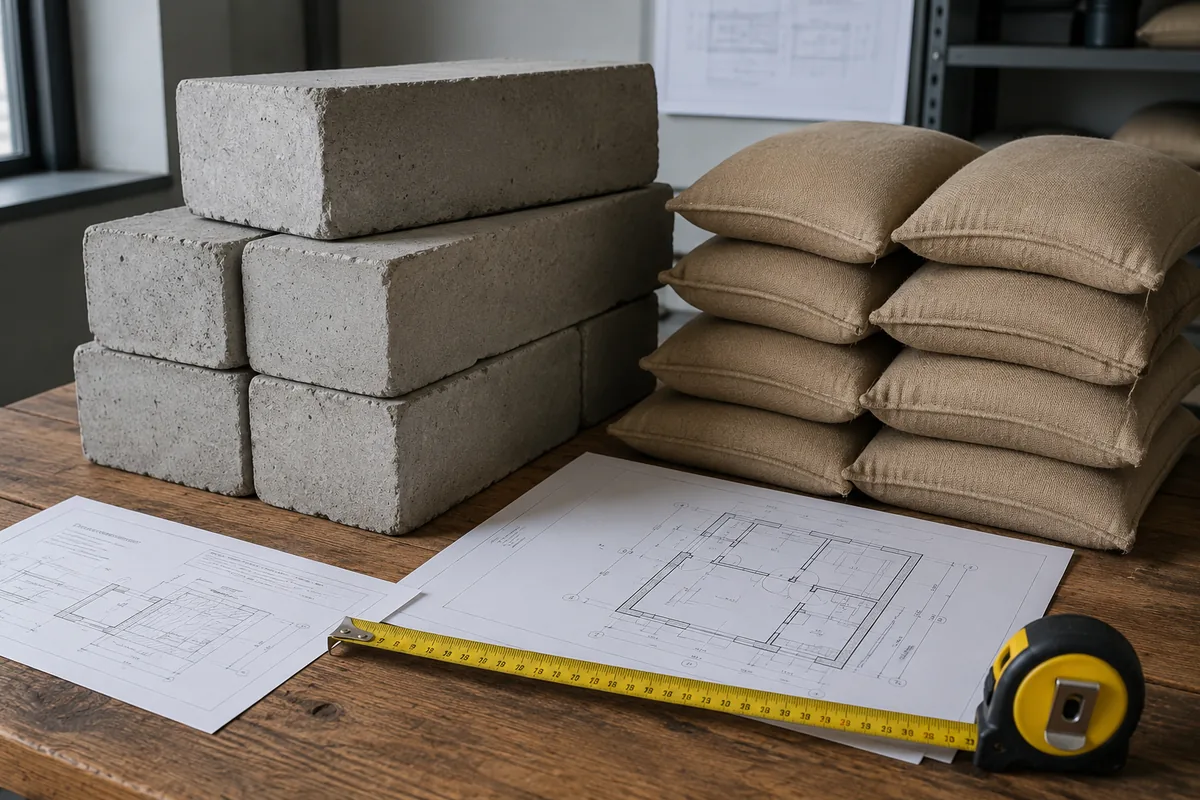
What this guide covers: This article explains the physics of gamma radiation shielding, defines the Protection Factor (PF) metric used by FEMA and civil defense planners, and provides a data-driven comparison of the most accessible shielding materials — concrete, earth, brick, lead, steel, and water — with exact thickness requirements derived from NRC regulatory data and EPA radiation protection guidelines.
Table of Contents
- How Radiation Shielding Works: The Physics
- Understanding the Protection Factor (PF)
- Half-Value Layer: The Key Measurement
- Material Comparison Table
- Concrete: The Practical Standard
- Packed Earth and Sandbags
- Lead: High Efficiency, High Cost
- Water: Dual-Purpose Shielding
- Brick and Steel
- Applying This Data to Your Home Shelter
- Frequently Asked Questions
How Radiation Shielding Works: The Physics
Nuclear fallout produces three primary types of ionizing radiation: alpha particles, beta particles, and gamma rays. For shelter planning purposes, gamma radiation is the dominant hazard. Alpha particles are stopped by a sheet of paper or the outer layer of skin; beta particles are blocked by a few millimeters of aluminum or a layer of clothing. Gamma rays, however, are high-energy photons that penetrate deeply into matter and require substantial mass to attenuate.
Gamma radiation is attenuated — not blocked outright — by shielding material. Each layer of material reduces the intensity of the radiation passing through it by a fixed percentage, a relationship described by the exponential attenuation law. This means that doubling the thickness of a material does not halve the dose twice; it reduces it by a consistent factor at each layer. The practical implication is that more mass always means more protection, and the denser the material, the more effective each inch of thickness becomes.
According to the EPA's Radiation Protection Basics, the three fundamental methods of reducing radiation exposure are: Time (minimize time near the source), Distance (maximize distance from the source), and Shielding (place dense material between yourself and the source). For fallout scenarios, shielding is the most controllable variable for civilians sheltering in place.
Understanding the Protection Factor (PF)
The Protection Factor (PF) is the standard metric used by FEMA, civil defense planners, and the NRC to quantify how effectively a shelter reduces radiation exposure relative to being unshielded outdoors. The formula is straightforward:
Protection Factor (PF) = Outdoor Dose Rate ÷ Indoor Dose Rate
A PF of 10 means you receive 1/10th of the outdoor dose. A PF of 100 means you receive 1/100th.
FEMA's guidance for radiological emergencies recommends seeking locations with a minimum PF of 40. A PF of 40 reduces your exposure to 2.5% of the outdoor level — sufficient to protect against most fallout scenarios where outdoor dose rates are in the range of 1–10 R/hr in the first 24 hours after a detonation. The following reference points are used by civil defense planners:
- PF 1–2: Open vehicles, convertibles, thin-walled structures — essentially no protection
- PF 3–10: Wood-frame houses, vehicles with windows closed
- PF 10–40: Brick or concrete buildings, upper floors of multi-story structures
- PF 40–200: Basement of a multi-story concrete or brick building
- PF 200–1,000+: Purpose-built fallout shelters with reinforced concrete and earth cover
Half-Value Layer: The Key Measurement
The Half-Value Layer (HVL) is the thickness of a given material required to reduce gamma radiation intensity by 50%. It is the fundamental unit used by radiation physicists and engineers when designing shielding systems. The HVL varies by material density: lead has an HVL of approximately 0.5 inches (1.3 cm) for typical fallout gamma energies, while packed earth requires approximately 3.6 inches (9 cm) to achieve the same 50% reduction.
To calculate the number of HVLs needed for a target Protection Factor, use the following relationship: Number of HVLs = log₂(PF). For a PF of 100, you need approximately 6.6 HVLs. For a PF of 40, you need approximately 5.3 HVLs. This is why the thickness requirements in the comparison table below scale with the target PF rather than being fixed values.
Material Comparison Table
The following table compares the most commonly available radiation shielding materials by density, HVL for gamma radiation, and the thickness required to achieve Protection Factors of 40 and 100. Data is derived from NRC shielding data and the EPA Radiation Protection program.
| Material | Density (g/cm³) | HVL (inches) | Thickness for PF 40 | Thickness for PF 100 | Practicality |
|---|---|---|---|---|---|
| Lead Most Efficient | 11.3 | ~0.5 in (1.3 cm) | ~2.6 in (6.6 cm) | ~3.3 in (8.4 cm) | Excellent efficiency; expensive and heavy for large areas |
| Steel / Iron | 7.9 | ~0.9 in (2.3 cm) | ~4.8 in (12 cm) | ~6.0 in (15 cm) | Good; available as structural elements or plates |
| Concrete Best Practical | 2.3 | ~2.4 in (6 cm) | ~12.7 in (32 cm) | ~15.8 in (40 cm) | Widely available; basements already provide significant PF |
| Brick | 1.8–2.0 | ~3.0 in (7.6 cm) | ~15.9 in (40 cm) | ~19.8 in (50 cm) | Good; common in older construction; can be stacked |
| Packed Earth / Sandbags | 1.5–1.7 | ~3.6 in (9 cm) | ~19 in (48 cm) | ~24 in (61 cm) | Excellent availability; ideal for augmenting existing shelters |
| Water | 1.0 | ~7.0 in (18 cm) | ~37 in (94 cm) | ~46 in (117 cm) | Dual-purpose (shielding + hydration); bulky but accessible |
| Wood | 0.5–0.8 | ~11 in (28 cm) | ~58 in (147 cm) | ~73 in (185 cm) | Poor shielding per inch; not recommended as primary shield |
Sources: U.S. Nuclear Regulatory Commission (NRC); U.S. Environmental Protection Agency (EPA). HVL values are approximate for Cs-137 gamma energies (~0.66 MeV), representative of nuclear fallout.
Concrete: The Practical Standard for Home Shelters
Concrete is the most practical radiation shielding material for civilian home shelters because it is already present in most residential basements and foundations. A standard poured concrete basement wall is typically 8–12 inches thick, providing a PF of approximately 20–50 depending on wall configuration and the geometry of the shelter space. When combined with the concrete floor above and the earth surrounding the below-grade walls, a basement shelter can realistically achieve a PF of 40–200.
The key variable is geometry: the shelter occupant must be surrounded by shielding material on all sides, including overhead. A basement room in the center of a building, away from exterior walls, benefits from additional shielding from the building structure above and the surrounding soil. Moving to an interior room on the lowest floor is always preferable to remaining near exterior walls or windows.
Augmenting Concrete Shelters
If your basement walls are thinner than ideal, you can increase the effective PF by stacking dense materials against the interior of exterior walls. Sandbags filled with packed earth, concrete blocks, or even books and paper (which have moderate density) can meaningfully increase the mass between occupants and the outside environment. Each additional HVL of material added to an existing wall doubles the Protection Factor.
Packed Earth and Sandbags: The Emergency Standard
Packed earth is the historical standard for fallout shelter construction, used extensively in civil defense planning from the 1950s through the 1980s. The FEMA National Preparedness guidelines continue to reference earth cover as a primary shielding strategy. At a density of approximately 1.5–1.7 g/cm³, packed earth requires about 36 inches (3 feet) to achieve a PF of 100 — which is why underground shelters with 3 feet of earth cover are considered highly effective.
For improvised shelters, sandbags are the most accessible form of earth shielding. Standard military sandbags filled with moist soil weigh approximately 35–40 lbs each and can be stacked against walls, over doorways, or used to create a protected inner room within an existing basement. A stack of sandbags 24 inches deep provides a PF of approximately 40–50 against gamma radiation from the direction of the stack.
Earth shielding is effective only when it is dense and continuous. Loose, dry sand is less effective than moist, compacted soil. Gaps, doors, and ventilation openings significantly reduce the overall PF of any shelter. FEMA recommends sealing all gaps with duct tape and plastic sheeting during the first 24 hours of a fallout event.
Lead: Maximum Efficiency, Practical Limitations
Lead is the most efficient gamma radiation shielding material available to civilians, with an HVL of approximately 0.5 inches for typical fallout gamma energies. This means a lead sheet just 3.3 inches thick can achieve a PF of 100 — far thinner than any other material in the comparison table. Lead is used in medical X-ray rooms, nuclear power plant control rooms, and industrial radiography facilities for precisely this reason.
However, lead presents significant practical limitations for home shelter use. At a density of 11.3 g/cm³, a 4×8 foot lead sheet just 1 inch thick weighs approximately 470 lbs — far beyond what most residential floors can safely support, and prohibitively expensive for large-area coverage. The most practical application of lead in a home shelter context is targeted use: lead-lined curtains or panels over ventilation openings, or lead aprons placed over the most exposed positions within an existing concrete shelter.
Water: Dual-Purpose Shielding
Water is an underappreciated shielding material for civilian preparedness. While its HVL of approximately 7 inches makes it less efficient than concrete or lead per unit of thickness, water has a unique advantage: it serves simultaneously as a radiation shield and a critical survival resource. Surrounding a shelter space with water storage containers — 55-gallon drums, water bricks, or even filled bathtubs — on the walls facing the exterior provides meaningful additional shielding while ensuring an adequate water supply for the shelter period.
Water is also particularly effective at attenuating neutron radiation, which is a concern in the immediate vicinity of a nuclear detonation. The hydrogen atoms in water are highly effective at slowing and absorbing neutrons through elastic scattering. For shelters within a few miles of a detonation site, water shielding on the walls provides a measurable reduction in neutron dose in addition to gamma attenuation.
Brick and Steel
Brick construction, common in pre-1970s residential and commercial buildings, provides moderate gamma shielding. A standard 8-inch brick wall has an HVL of approximately 3 inches, meaning it provides roughly 2.5 HVLs — a PF of approximately 5–6 on its own. However, a full brick exterior wall combined with an interior concrete block wall and the air gap between them can achieve a combined PF of 15–25, which is significantly better than a wood-frame structure.
Steel is more efficient than concrete per inch but less accessible in large quantities for civilian use. Structural steel beams and columns in commercial buildings contribute meaningfully to the overall shielding of interior spaces. For improvised shelters, steel filing cabinets, safes, and appliances can be positioned to provide directional shielding against the most exposed wall of a shelter room.
Applying This Data to Your Home Shelter
The practical takeaway from this data is that the best shelter is the one you can access immediately. A purpose-built lead-lined room is theoretically superior, but a basement with existing concrete walls and augmented sandbag coverage will protect you far better than any above-ground location. The NRC's guidance on shelter-in-place emphasizes that even imperfect shielding dramatically reduces dose compared to being outdoors during peak fallout deposition.
Step-by-Step Shelter Optimization
- Step 1 — Identify your lowest floor: Go to the basement or lowest level of the most solid building available. Interior rooms away from exterior walls are preferable.
- Step 2 — Assess overhead shielding: Count the floors and material above you. Each additional floor of a concrete or brick building adds approximately 10× to the PF.
- Step 3 — Augment weak walls: Stack sandbags, concrete blocks, or dense furniture against exterior-facing walls. Even 12 inches of packed earth against a wall doubles its shielding contribution.
- Step 4 — Seal openings: Use plastic sheeting and duct tape to seal windows, doors, and ventilation openings. This addresses both radiation ingress and radioactive particle contamination.
- Step 5 — Calculate your supply needs: Use our Fallout Shelter Supply Calculator to determine the exact water, food, and KI quantities needed for your household based on shelter duration.
📊 Calculate Your Exact Shelter Supplies
Use our free FEMA-based calculator to determine the precise water volume, caloric intake, and Potassium Iodide requirements for your household — based on shelter duration and occupant count.
Open the Fallout Shelter Calculator →Frequently Asked Questions
What is the best material for radiation shielding in a home shelter?
For gamma radiation — the primary hazard from nuclear fallout — the most practical shielding materials for home shelters are dense concrete, packed earth, and brick. Lead offers the highest shielding efficiency per inch but is expensive and impractical in large quantities. A basement with 12 inches of concrete overhead provides a Protection Factor of approximately 100, reducing radiation exposure to 1% of the outdoor level. The NRC recommends maximizing the mass of material between occupants and the outside environment.
What is a Protection Factor (PF) in radiation shielding?
A Protection Factor (PF) is a ratio indicating how much a shelter reduces radiation exposure compared to being outdoors. A PF of 10 means you receive one-tenth (10%) of the outdoor dose; a PF of 100 means you receive one-hundredth (1%). FEMA recommends seeking shelters with a PF of at least 40 during a radiological emergency. PF is determined by the type, density, and thickness of shielding material surrounding the shelter space.
How thick does concrete need to be to stop gamma radiation?
According to NRC data, the half-value layer (HVL) for gamma radiation in concrete is approximately 2.4 inches (6 cm). To achieve a Protection Factor of 100, you need approximately 6.6 HVLs, or roughly 16 inches (40 cm) of concrete. A standard basement with 8–12 inches of concrete overhead provides a PF of approximately 40–100, meeting FEMA's minimum recommended threshold.
Can water be used as radiation shielding?
Yes. Water is an effective gamma radiation shield with an HVL of approximately 7 inches (18 cm). While less efficient than concrete per inch, water serves dual purposes: shielding and hydration reserve. Surrounding a shelter space with water containers on exterior-facing walls can meaningfully increase the overall Protection Factor, and water is particularly effective at attenuating neutron radiation due to its hydrogen content.
References and Official Sources
- U.S. Nuclear Regulatory Commission — Appendix B to Part 20: Annual Limits on Intake
- U.S. Environmental Protection Agency — Radiation Protection Basics
- FEMA — Nuclear Preparedness and Shelter-in-Place Guidance
- Ready.gov (FEMA) — Nuclear Explosion: What to Do
- CDC — Radiation Emergencies: Shelter-in-Place Guidance