Nuclear EMP Protection & Faraday Cage Guide
Key Takeaways
- A High-Altitude Electromagnetic Pulse (HEMP) from a nuclear detonation in the upper atmosphere can destroy unshielded solid-state electronics across an entire continent in a fraction of a second.
- The electrical grid acts as a giant antenna for the pulse — plugged-in devices are the most vulnerable because miles of power lines funnel EMP energy directly into your home's outlets.
- A true Faraday cage requires a continuous conductive shield — a tightly sealed galvanized steel container with no gaps. Electronics inside must be insulated from the metal walls.
- Disconnecting devices from the grid is your first and most immediate line of defense — unplug all critical survival electronics before a nuclear emergency.
- Solar inverters and charge controllers are highly vulnerable — always keep a spare set permanently stored in a Faraday cage.
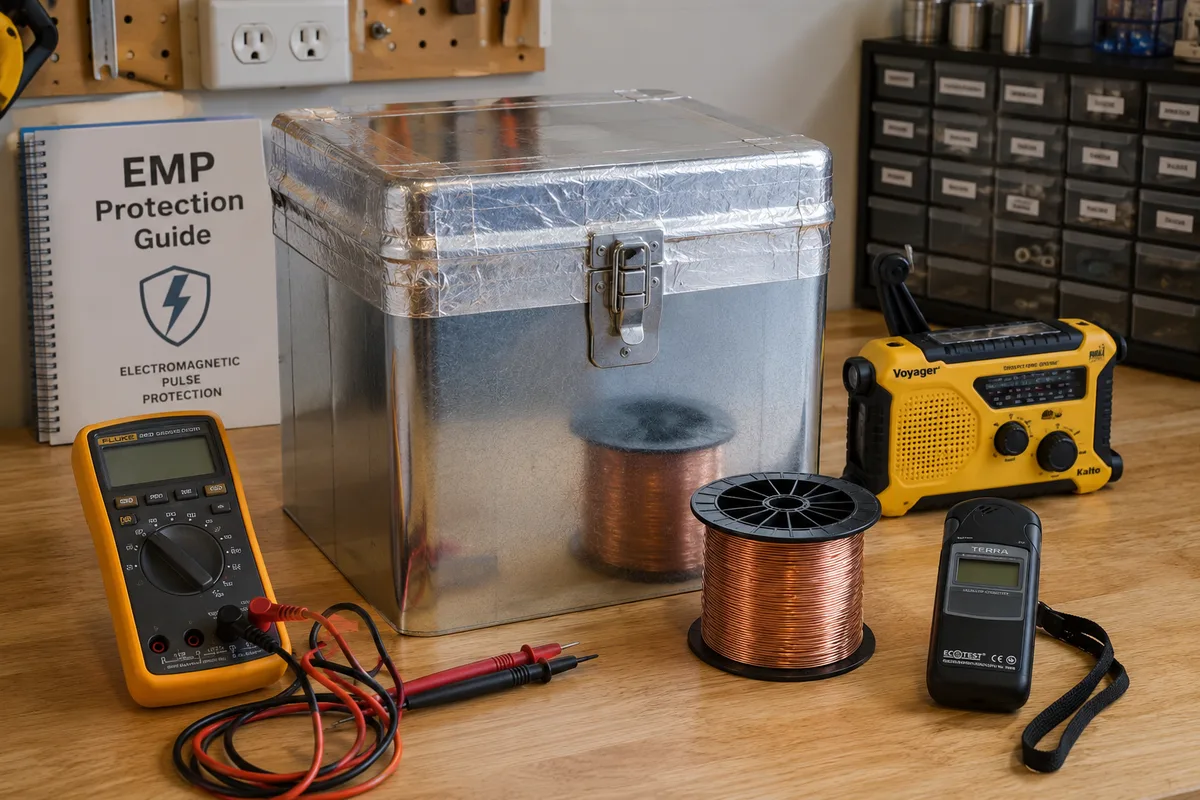
Most nuclear preparedness guides focus on blast radius and radiation fallout — and rightly so. But a third threat is rarely discussed with the same urgency: a High-Altitude Electromagnetic Pulse, or HEMP. Unlike the direct effects of a nuclear detonation, a HEMP attack requires no ground-level explosion. A single warhead detonated 250 miles above the center of the continental United States could generate an electromagnetic shockwave powerful enough to disable unshielded electronics across the entire country. The 2008 EMP Commission Report to Congress identified this as one of the most asymmetric threats facing modern civilization.
The good news is that protecting your critical survival electronics from an EMP is achievable with inexpensive, readily available materials. This guide explains the physics, identifies your most vulnerable equipment, and provides a step-by-step approach to building effective Faraday protection — based on guidance from FEMA, the Congressional EMP Commission, and the Department of Defense.
What is a Nuclear HEMP and How Does it Destroy Circuits?
A High-Altitude Electromagnetic Pulse is generated when a nuclear weapon is detonated at altitudes between 25 and 500 kilometers above the Earth's surface. At that altitude, the gamma rays released by the explosion interact with the upper atmosphere, stripping electrons from air molecules in a process called Compton scattering. These free electrons are then accelerated by the Earth's magnetic field, generating an intense, rapidly changing electromagnetic field that radiates downward across a vast geographic area. The EMP Commission's 2008 report documented that a single warhead detonated at 400 km altitude over the center of the U.S. would expose the entire continental United States to the pulse simultaneously.
The destructive mechanism is straightforward: the rapidly changing electromagnetic field induces massive surges of electric current in any conductive material — wires, circuit traces, antenna leads, and power lines. Modern microchips and solid-state components in survival gear operate at voltages between 1.8V and 5V, with tolerances measured in millivolts. The induced voltage from a HEMP can reach thousands of volts in exposed conductors in microseconds. The result is catastrophic and irreversible: transistor junctions burn out, capacitors rupture, and integrated circuits are permanently destroyed. There is no recovery — the device simply stops working.
The Electrical Grid: A Giant Antenna
Of all the vulnerabilities in a modern home, the electrical grid is the most dangerous during a HEMP event. The hundreds of miles of transmission lines, distribution cables, and household wiring that connect your home to the grid act as an enormous receiving antenna for the pulse. When the EMP wave passes, it induces a powerful surge current through every conductor connected to the grid. This energy travels at the speed of light through the power lines, into the transformer on your street, through your breaker panel, and directly into every outlet in your home. Any device plugged into a wall outlet at the moment of the pulse — regardless of whether it is switched on — receives the full force of that surge.
This is why disconnecting your critical survival electronics from the grid is the single most important immediate action you can take. An emergency hand-crank radio stored in a drawer but unplugged from the wall has a dramatically higher survival probability than the same radio plugged into a charger. The EMP Commission's testing found that the grid-coupled threat (E3 component) is often more damaging to infrastructure than the direct radiated pulse (E1 component) because it affects equipment that would otherwise be partially shielded by building structures. Establish a habit now: keep your Geiger counter, emergency radio, and backup communication devices unplugged and stored away from power outlets.
How to Build a True Faraday Cage
A Faraday cage works by distributing an incoming electromagnetic charge around the exterior of a continuous conductive enclosure, preventing the field from penetrating to the interior. The physics requires that the conductive shell be complete and unbroken — any gap, seam, or penetration larger than the wavelength of the incoming radiation creates a leak point. For the E1 component of a nuclear HEMP (which has frequency components up to 1 GHz), this means gaps must be smaller than approximately 30 centimeters. A tightly sealed galvanized steel trash can, a military-surplus ammunition can, or a purpose-built steel box with a gasketed lid all meet this requirement. The lid must make solid metal-to-metal contact with the body of the container around its entire perimeter — a loose-fitting lid with visible light gaps will not provide adequate protection.
The most critical and most commonly overlooked step is insulating the electronics from the metal walls of the cage. If a device inside the cage touches the conductive walls, the cage's exterior charge can be conducted directly into the device through that contact point, defeating the entire purpose of the enclosure. Wrap each device in at least two layers of heavy-duty aluminum foil, or place it inside a sealed plastic bag or cardboard box before placing it in the steel container. This creates an air gap between the device and the cage walls. For added protection, line the interior of the steel container with cardboard or foam rubber before placing your wrapped devices inside. Test your cage by placing a cell phone inside the sealed container and attempting to call it — a properly shielded enclosure will block all cellular signal.
Protecting Radios, Geiger Counters, and Solar Panels
Solar panels themselves are relatively resilient to EMP — the photovoltaic cells are passive semiconductor junctions with no active electronics, and their large physical size means the induced voltage per unit length is manageable. However, the balance-of-system components are extremely vulnerable. Solar charge controllers, grid-tie inverters, and MPPT regulators contain the same microprocessors and MOSFETs that are destroyed by EMP-induced surges. A solar array without a functioning charge controller is useless. The EMP Commission specifically identified power electronics — inverters, controllers, and smart meters — as among the most vulnerable components in any electrical system. The practical solution is to purchase one or two spare charge controllers appropriate for your system and store them permanently in a sealed Faraday cage. At $30–$150 each, this is one of the highest-value preparedness investments available.
For communication and monitoring equipment, the priority list is clear. Emergency HAM radio transceivers (particularly handheld VHF/UHF units) are irreplaceable for post-event communication when the cellular network is down. Geiger counters and personal dosimeters are essential for assessing radiation levels before leaving shelter. Hand-crank NOAA weather radios provide the only reliable source of official emergency information when the power grid is down. All three categories should have at least one backup unit stored in a Faraday cage at all times. Additionally, consider storing spare ignition modules for older vehicles, backup LED flashlight drivers, and any medical devices that rely on electronic components. The goal is not to protect every device you own — it is to ensure that the specific tools you need to survive the first 14 days after a nuclear event are operational when you need them.
EMP Vulnerability by Device Category
| Device Category | EMP Vulnerability | Recommendation |
|---|---|---|
| Plugged-in devices (any) | CRITICAL | Unplug immediately; store in Faraday cage |
| Solar charge controllers / inverters | CRITICAL | Keep spare in Faraday cage permanently |
| HAM radios / emergency radios | HIGH | Store backup unit in Faraday cage |
| Geiger counters / dosimeters | HIGH | Store backup in Faraday cage |
| Modern vehicles (post-1980) | MODERATE | May stall; older mechanical vehicles more resilient |
| Solar panels (photovoltaic cells) | LOW | Panels survive; protect the controller, not the panels |
| Mechanical watches / analog gauges | MINIMAL | No protection needed |
→ Stock Your Faraday Cage
Know which electronics to protect? See the complete FEMA-based Nuclear Survival Kit checklist — including the specific Geiger counters, radios, and KI tablets that belong in every emergency kit.
View Nuclear Survival Kit Guide →→ Build Your Physical Shelter
EMP protection keeps your electronics working. Radiation shielding keeps you alive. Learn which materials — concrete, earth, lead — provide the highest Protection Factor for a home fallout shelter.
View Radiation Shielding Guide →Frequently Asked Questions
Modern vehicles manufactured after roughly 1980 contain electronic control units (ECUs), fuel injection computers, and ignition systems that are vulnerable to a strong HEMP. A high-altitude nuclear EMP could cause these systems to fail, stalling or permanently disabling the vehicle. Older, pre-electronic mechanical vehicles with carburetors and points-based ignition are significantly more resilient because they have no microprocessors to burn out. FEMA and EMP Commission reports suggest that while many modern cars may stall, a significant portion could be restarted after the pulse passes — but vehicles with more complex electronics are at greater risk of permanent damage.
A microwave oven is not a reliable Faraday cage for EMP protection. Its shielding is engineered to contain microwave radiation at a specific frequency (2.45 GHz) to prevent leakage, not to block the broad spectrum of frequencies generated by a nuclear EMP. The door seals, ventilation gaps, and the power cord penetration all create potential leak points for EMP energy. For reliable protection, use a purpose-built galvanized steel container with a tight-fitting lid and insulate the electronics inside from the metal walls.
For a small, portable EMP shield — such as a galvanized steel trash can or ammunition can — grounding is not strictly necessary and can sometimes create a vulnerability if done incorrectly. A properly sealed, ungrounded metal enclosure still distributes the electromagnetic charge around its exterior, protecting the contents. Grounding becomes more relevant for large, fixed installations like building-scale shielded rooms. For civilian preparedness purposes, focus on achieving a complete, continuous conductive seal around the enclosure rather than grounding.
Prioritize electronics critical for post-event survival and communication: emergency hand-crank or battery-powered NOAA weather radios, Geiger counters and dosimeters, HAM radio transceivers, solar charge controllers and inverters, spare vehicle ignition modules, and battery-powered flashlights with LED drivers. Store at least one backup of each critical device in a Faraday cage at all times. Medical devices like insulin pumps or pacemaker backup units should also be considered.
A simple practical test: place a fully charged cell phone inside your sealed Faraday cage and call it from another phone. If the call goes through or the phone shows signal, the cage is leaking RF energy and will not provide adequate EMP protection. A properly shielded enclosure will block all cellular signal. For a more rigorous test, use an AM/FM radio tuned to a strong station — if you can hear the broadcast inside the sealed cage, the shielding is insufficient.
IMPORTANT DISCLAIMER
This guide is for educational purposes only, based on publicly available data from the Congressional EMP Commission, FEMA, and the Department of Defense. In an actual emergency, always follow instructions from local authorities and emergency management agencies. Consult official sources before making preparedness decisions.