Best Gas Mask for Nuclear Fallout & CBRN Filter Guide
Key Takeaways
- N95 masks stop radioactive dust (alpha and beta particles) from entering your lungs, but they do not block gamma radiation — the most penetrating and dangerous form of nuclear fallout.
- A full-face respirator with a certified CBRN filter is the gold standard for respiratory protection during a nuclear or radiological emergency, protecting both lungs and eyes.
- The 40mm NATO thread is the universal standard for CBRN filters — it fits most military and civilian full-face gas masks available worldwide.
- Potassium iodide (KI) and a gas mask serve different purposes — KI protects the thyroid gland, while a mask protects the respiratory tract. You need both.
- Paint respirators and half-face masks are not adequate for nuclear fallout — they lack CBRN certification and do not seal properly around the face.
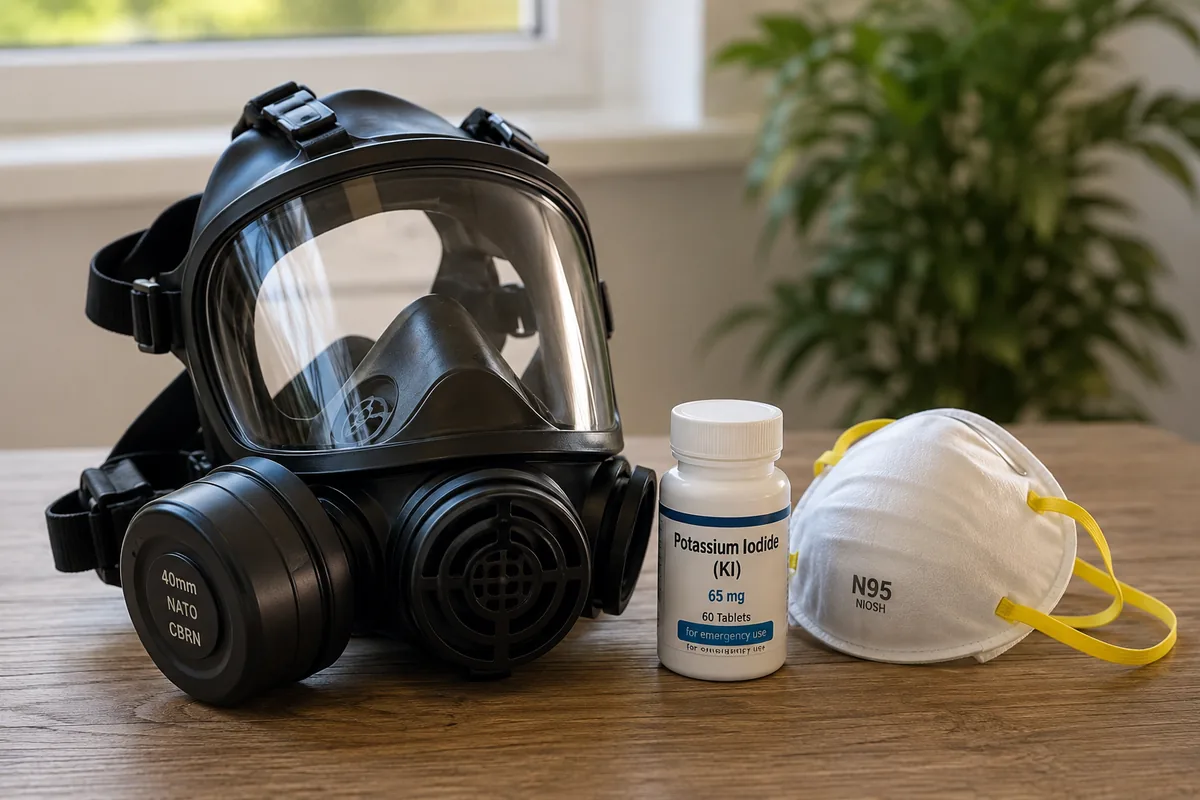
Do N95 Masks Protect Against Radiation?
An N95 respirator is defined by the U.S. National Institute for Occupational Safety and Health (NIOSH) as a filtering facepiece respirator that captures at least 95% of airborne particles at the most-penetrating particle size of 0.3 microns — a threshold that includes radioactive fallout dust, alpha-emitting particles, and beta-emitting aerosols generated by nuclear detonations and reactor accidents. In a nuclear emergency, an N95 worn with a proper face seal meaningfully reduces inhalation of radioactive particulate matter. FEMA's Planning Guidance for Response to a Nuclear Detonation (3rd edition, 2022) explicitly states that any respiratory protection is better than none during active fallout, and that improvised face coverings — including N95 respirators — can reduce the inhaled dose by a factor of 2 to 10 depending on fit and particle size distribution.
The critical limitation of N95 respirators in a radiological context is that they provide zero protection against gamma radiation, which the International Commission on Radiological Protection (ICRP) classifies as a highly penetrating electromagnetic emission with energies typically ranging from 0.1 MeV to 10 MeV — sufficient to traverse an N95 filter, clothing, and several centimeters of concrete without meaningful attenuation. No wearable mask stops gamma rays; only dense shielding materials such as concrete (half-value layer ≈ 6 cm for Co-60 gamma), lead (HVL ≈ 1 cm), or packed earth (HVL ≈ 9 cm) provide meaningful gamma attenuation, as documented in NRC Regulatory Guide 1.91. An N95 is therefore appropriate for short-term outdoor evacuation to reduce particle inhalation, but it is not a substitute for shelter-in-place or a full CBRN-rated respirator for extended radiological exposure.
What is a CBRN Filter?
A CBRN filter is defined as a certified respiratory cartridge designed to provide simultaneous protection against Chemical, Biological, Radiological, and Nuclear airborne hazards by combining two distinct filtration mechanisms: an activated carbon layer that adsorbs toxic industrial chemicals, nerve agents (e.g., sarin, VX), and blister agents at the molecular level, and a HEPA-grade particulate filter rated to capture at least 99.97% of particles at 0.3 microns — the size range that encompasses radioactive fallout dust, aerosolized radiological material, and biological warfare agents. According to NATO STANAG 4155 and the U.S. Department of Defense CBRN Survivability Policy (DoDD 3150.08), a compliant CBRN filter must demonstrate a minimum protection factor of 2,000 against a standard test aerosol, meaning it reduces the inhaled concentration of hazardous agents to 0.05% of the ambient concentration when used with a properly sealed full-face respirator.
The 40mm NATO thread — standardized under NATO STANAG 4155 and adopted by all 32 NATO member nations — is the universal attachment interface for CBRN filters, with a defined thread pitch that ensures interoperability between filters and masks from different manufacturers and countries. In the United States, CBRN filters for civilian use must additionally meet NIOSH 42 CFR Part 84 certification requirements, which mandate independent laboratory testing of filtration efficiency, breathing resistance (maximum 25 mm H₂O at 85 L/min airflow), and canister service life under simulated operational conditions. When purchasing a gas mask for nuclear fallout preparedness, verifying that the filter carries both NIOSH certification and 40mm NATO thread compatibility is the minimum due-diligence standard.
The Best Gas Mask for Nuclear Fallout
A full-face CBRN respirator is defined by the U.S. Department of Defense and FEMA as a tight-fitting, full-facepiece air-purifying respirator that simultaneously seals the mouth, nose, and eyes against airborne chemical, biological, radiological, and nuclear hazards — providing a minimum assigned protection factor (APF) of 50 under OSHA 29 CFR 1910.134, meaning the wearer's inhaled concentration is reduced to no more than 2% of the ambient hazard level. For nuclear fallout specifically, the full-face design is critical because radioactive iodine-131 (half-life: 8.02 days) and fine fallout particulate matter can be absorbed not only through the respiratory tract but also through the conjunctival mucous membranes of the eyes — an exposure pathway that a half-face mask or N95 leaves entirely unprotected. The CDC's Radiation Emergencies guidance and FEMA's Nuclear Detonation Response Guidance both identify full-face respirators as the appropriate standard for radiological emergency response personnel operating in contaminated environments.
When evaluating gas masks for nuclear preparedness, the key technical specifications to verify are: a CBRN-certified filter cartridge (not a standard industrial P100 or OV filter, which are not rated for radiological or chemical warfare agents), a 40mm NATO thread for filter compatibility, a wide-view polycarbonate visor with a minimum optical class of 1 per EN 166 standards (anti-scratch and anti-fog coated), and a five- or six-point adjustable harness system that achieves a face seal leakage rate of less than 0.05% under the EN 136 or NIOSH fit-test protocol. The U.S. Army CBRN Soldier Training Program specifies that personnel must be able to don a properly fitted gas mask within 9 seconds of the alarm — for civilian preparedness, a 30-second donning time under stress is a practical benchmark. A mask that cannot be correctly fitted and sealed in that window provides protection far below its rated specifications. See our complete Nuclear Survival Kit guide for a full list of recommended preparedness equipment.
Potassium Iodide vs. Gas Mask: What is the Difference?
Potassium iodide (KI) is defined by the U.S. Food and Drug Administration (FDA) and the CDC as a thyroid-blocking agent that, when administered at the recommended dose (130 mg for adults, 65 mg for children aged 3–18, as specified in FDA guidance document 21 CFR 310.545), saturates the thyroid gland with stable iodine-127, preventing the uptake of radioactive iodine-131 — a fission product with a physical half-life of 8.02 days released in large quantities during nuclear detonations and reactor accidents. The World Health Organization (WHO) and IAEA both classify KI as an effective thyroid-blocking countermeasure when taken within 24 hours before or up to 4 hours after radioactive iodine exposure. However, KI has zero efficacy against any other radioactive isotope — including cesium-137, strontium-90, or plutonium-239 — and provides no protection to the lungs, skin, or eyes. Learn more about correct dosing and timing in our Potassium Iodide (KI) dosage guide.
A gas mask with a CBRN filter addresses a completely different threat: inhalation of radioactive particles through the respiratory tract. Inhaling fallout dust is one of the primary internal contamination pathways in a nuclear emergency, and it is the one that a gas mask directly prevents. Neither tool replaces the other. A person who takes KI but has no respiratory protection is still at significant risk from inhaled fallout particles affecting the lungs and other organs. A person wearing a gas mask but who has not taken KI is still at risk of thyroid contamination from radioactive iodine that was absorbed through the skin or ingested before the mask was donned. The correct approach — consistent with FEMA, CDC, and IAEA guidance — is to treat KI and a CBRN-rated gas mask as complementary components of a complete nuclear preparedness kit, alongside stored water, food, and a designated shelter-in-place location. For a comprehensive checklist of everything you need, see our nuclear fallout water purification guide and the full Nuclear Survival Kit.
Frequently Asked Questions
Essential Knowledge
Potassium Iodide (KI): Dosage, Timing & Who Should Take It →
Your gas mask protects your lungs. KI protects your thyroid. Learn the correct dose and when to take it.
Complete Checklist
Nuclear Survival Kit: 17 Essential Items →
Gas mask, KI tablets, water, food — see the complete FEMA-based kit checklist in one place.
Important Disclaimer
This guide is for educational purposes only, based on publicly available FEMA, CDC, and NIOSH guidelines. In an actual emergency, always follow instructions from local authorities and emergency management agencies. Consult official sources before making preparedness decisions.